What should companies be doing to prevent disasters such as the ongoing catastrophe in the Gulf of Mexico, with its tragic loss of life and environmental devastation? Granted, some disasters are just ‘Black Swans’ (see Nassim Nicholas Taleb’s writings on this topic) and can’t be predicted. But company safety procedures can go a long way toward mitigating the risks of accidents and their potential effects.
Having served as a company safety officer and having written about industrial safety some years ago, I was very interested in the experience published today by Robert X. Cringely on his I, Cringely blog — see “Doing the Right Thing.”
Cringely republishes a comment from one of his readers, a Monsanto engineer, who recounts how Monsanto learned from the calamitous April 16, 1947, industrial accident at Texas City harbor. That accident was caused by a fire on a ship, not by Monsanto. However, the resulting explosion destroyed Monsanto’s plant, along with other facilities at the port and thousands of homes. Almost 600 people were killed. (See the Wikipedia article on the Texas City Disaster and the series of photos at the Portal to Texas History.) Here’s an aerial view of the Monsanto plant and the port after the accident:
As a result of Texas City, Monsanto developed a stronger culture of safety, says Cringely’s reader:
They developed technology to better control chemical process. They developed standards to built safer facilities. They didn’t do this alone. They worked closely with other chemical companies. The whole industry invested in best practices and shared what they learned. When I started my job [in the 1970s] I was given a set of “standards” consisting of 3 binders, each 6 inches thick — serious reading.
Union Carbide’s terrible accident in Bhobal, India, in 1984 also became a crucial lesson for industry players. Soon after Bhopal, Monsanto officials had “reverse-engineered” the disaster and reiterated company policy, emphasizing that “all plants are to be built to USA or local country safety standards, whichever is better.”
Further studies within Monsanto after Bhopal had a profound effect on the company’s business:
The result of the study was sweeping changes in how much material was stored in each facility. Many processes and lines of business were deemed too risky to continue and were shut down. Monsanto walked away from tens of millions in business to reduce risk and improve safety.
Monsanto also instituted new programs to train and equip local first-responders where its plants are and to reduce emissions “far exceeding EPA rules.”
These comments emphasize the value of adopting the stance of a “learning organization.” What kinds of company policies and practices can go the furthest in preventing accidents, loss of life, and environmental damage — and in minimizing the effects when accidents do occur?
Many people think of YouTube as a big time-waster with nothing but videos of animals dancing and guys getting whacked in their privates.
But as time goes on, I become more and more conscious YouTube as a great resource in many respects. For example, in my work as a writer and analyst, I’ve been making good use of corporate videos on YouTube, where it’s possible now to access in-depth presentations by company executives, scientists, and other experts.
Thanks to a mention yesterday in Boing Boing, I’ve learned about Khan Academy, which now has over 1,200 educational videos on YouTube. Using a very simple “chalk talk” format, Salman Khan, an engineer and manager, provides 10-20-minute video presentations on a huge variety of topics, including science, history, math, finance, economics, and more.
These videos would be useful as quick reviews or knowledge fill-ins for students, both adult and child, or for parents who are trying to help their kids with their studies. I also find them useful as a writer who needs to be able to get up-to-speed quickly on economics and finance topics.
Khan creates his videos on a tablet computer with pen input. Here’s an example of a video explaining the basics of banking:
Recently I’ve been studying the use of ethnography in large companies for product design and market strategy, which relates to some of the work I’ve done in usability and user experience.
In process of the research, I ran across an interesting anecdote about how the “big green button” on printers came out. I think it illustrates the value of video ethnography in product design, but, on an even more basic level, the value of simply watching how people live and work and use your product.
In a 1999 presentation for WPT Fest, Xerox PARC anthropologist Lucy Suchman described how she helped Xerox engineers understand how hard copiers were to use:
Around this time [1979] a project began at PARC to develop an intelligent, interactive expert system that would provide instructions to users in the operation of a particular photocopier, just put on the market and reported by its intended users to be “too complicated.” With Austin Henderson, I initiated a series of studies aimed first at understanding what made the existing machine difficult to use, and later at seeing just what happened when people engaged in “interactions” with my colleagues’ prototype expert advisor.
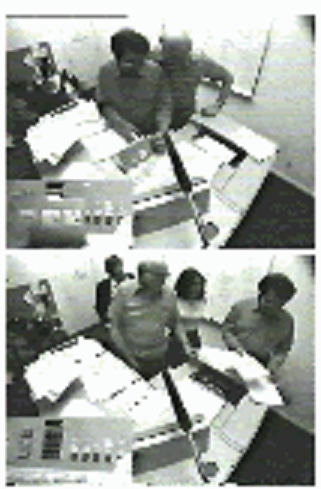
In order to explore these questions in detail we got a machine ourselves and installed it in our workplace. I then invited others of my co-workers, including some extremely eminent computer scientists, to try using the machine to copy their own papers for colleagues, with the understanding that a video camera would be rolling while they did so. This resulted among other things in what has become something of a cult video that I produced for John Seely Brown for a keynote address to CHI in 1983, titled “When User Hits Machine.” This image, taken from a 3/4″ reel-to-reel video recording made in 1982, shows two of my colleagues using the machine to make two-sided copies of a research paper. The CHI audience would recognize Allen Newell, one of the founding fathers of AI. His PARC colleague is a brilliant computational linguist named Ron Kaplan.
Video ethnographer Susan Faulkner of Intel relates one of the interesting results of Suchman’s video:
The film was shown to researchers and engineers at Xerox, and it led to significant changes in interface design, including the addition of the now ubiquitous large green button that allows users to quickly and easily make a copy.
A conversation earlier today with some of the innovation folks at IBM about their Smarter Planet initiative has got me revisiting some research we’ve done at the ILO Institute on a concept know as the “Internet of Things.” The essential idea is that objects in the physical environment around us are increasingly being embedded with networked technology, interacting with the larger network, and creating data. In fact, a video by IBM (shown below) suggests that there already might be more objects connected to the Internet than people.
I first encountered the Internet of Things concept in 2006 working on a report on the future of RFID (radio-frequency identification). RFID is a technology used to embed miniature wireless communications in objects of all kinds, such as packaging, boxes, equipment — even humans and animals. At that time I was in touch with some people working on the Internet of Things concept at MIT.
On a product level, says Murray, each item would be tagged by “a sort of Web page for each item” coded in HTML. “Thus, all products could be identified anywhere, instantly.” Plans include migrating from sticky tags to RFID devices embedded in cardboard cartons during the manufacturing process.
Murray speaks of this emerging Internet of Things in terms of the supply chain. However, the eventual possibilities go far beyond keeping track of products for supply chain management. If miniature Web pages and servers could be embedded in building materials, components of vehicles and aircraft, furniture, appliances, apparel, and other places, this could have huge implications for marketing, communication, and provision of services, not to mention changing the very nature of the world around us.
Wanting some further insights, I had a phone conversation with MIT’s Sanjay Sarma, an RFID expert at MIT. Sarma stressed the impact the Internet of Things will have on business:
MIT’s Sanjay Sarma tells ILO researchers that this Internet of Things is “going to have a huge impact,” and that RFID is one of the key enabling technologies. He points out that RFID creates a greatly increased connection between the physical world and the world of information by connecting more data to physical things and transferring it at much greater speeds in much greater volumes. “We used to connect data to the physical world through keyboards, but there’s only so much data you can get in through the keyboard. But with RFID it’s automatic and it’s happening all the time.”
Sarma says that the Internet of Things will allow you to “have control in your enterprise in a way that is completely unprecedented.” Sarma calls this control “high-resolution management—management with eyes everywhere, as opposed to management by gut reactions and guesswork.”
Earlier this year, we completed a report on how the Smart Grid is likely to affect the shape of the electric utility business in the future. If the smart grid initiative rolls out as anticipated (and utilities are working on this very aggressively right now), the electric grid in the U.S. will be transformed from the traditional century-old dumb one-way transmission utility into what Thomas Friedman has called an “Energy Internet” (see his book Hot, Flat, and Crowded, chapter 12, “The Energy Internet: When IT Meets ET”).
Under the Energy Internet paradigm, networked technologies will be embedded all through the electricity delivery system — in control facilities and substations, in smart meters at homes and businesses, in home appliances that will shut on and off in response to grid conditions, in electric vehicles and their charging systems, in home-based generating systems that will sell electricity back to the grid, and much more that we probably can’t imagine.
Friedman maintains that the smart grid will enable “a great energy transformation.” On page 286 of his book, he outlines what this could mean for utilities companies:
Utilities, instead of limiting their vision from the power plant to your home electricity meter, would be wholly transformed. Their universe would stretch from the generation of clean power on one end right into your home appliances, your car battery, and even the solar panels on your roof. Rather than just being a seller of dumb and dirty electrons, it would be an enabler of this whole smart grid-Energy Internet system. And it would make money from optimizing this system.
In effect, Friedman maintains, smart grid will bring utilities, businesses, and consumers together into an interactive energy market. Taking the reader forward in time, he projects how such a market might function (pages 277-278):
[N]ow that we’ve moved to the Energy Internet – the smart grid – utilities can run your refrigerator or adjust your thermostat in line with when the wind is blowing or the sun is shining. It can match the supply with the demand. Therefore, it can use more of these renewable power sources at much lower cost. When clouds block out the sun or the wind dies down, the utility’s smart grid lowers demand by raising prices (so your SBB [Smart Black Box] decides not to do the laundry then) or by adjusting your home temperature settings. And when the sun is shining brightly and the wind is howling, the utility runs your dryer at the lowest price. So there is now a direct correlation between how smart your grid is, how much energy efficiency it can generate, and how much renewable power it can use.
…. When the smart grid extended into a smart home all the way to a smart car, it created a whole new energy market on the other side of your electric meter. In the old days, there was no market beyond the raw dumb electrons that came into your house. Everything stopped at the meter, and you just paid the price calculated at the end of the month. But once your appliances became smart, and a Smart Black Box was introduced into your house, a market was also created beyond your meter and throughout your home, and, more broadly, inside every factory and business around the country.
How will the Internet of Things, a Smarter Planet, transform the world? My guess would be that what eventually emerges will surprise us all. As humans, our predictions tend to be vastly oversimplified. In our smart-grid report, we wrote,
It is good to remember that 20 years ago, experts were referring to the Internet as an “information superhighway” – not wrong in itself, but a vast oversimplification. How many pundits at that time could have foreseen today’s massive World Wide Web and e-commerce activity – not to mention Google or Facebook?
The implication, then, is that utility companies need to become generators not just of power but of innovation – watching for potential new ventures and business models that will surely arise out of such areas as smart-metering, electric vehicles, and renewables. Utilities need to start now building the organizational capabilities necessary to exploit the opportunities that will emerge in this networked energy marketplace – which means expanding R&D and internal venture funding, establishing entrepreneurial units and innovation teams, and building a new culture of innovation.
For some insights into the Internet of Things concept, I invite you to watch this thought-provoking video from IBM:
I thought this was a great example of innovative thinking in the design of workshop gadgets — see (“Self-sorting (sorta) bin“). It’s a way to quickly store hardware items in the shop:
Pingdom has put together a fascinating (and useful for innovation researchers) infographic on Google, providing details on Google’s organization, technologies, usage, finances, and more.
For example, the graphic shows us that Google allows employees to spend 20 percent of their time working on “blue-sky” projects and that 50 percent of Google’s products have resulted from that blue-sky time. 37.5 percent of the company’s employees work in R&D and 37 percent in sales and marketing. 97 percent of revenue comes from advertising.
Thanks to Boing Boing for pointing me to the infographic, which is linked here (click on the image to see it full-size):
If, like me, you’re fascinated by cutaway illustrations, you should take a look at the posters of nuclear reactors created at BibliOdyssey. Here’s a sample (this is a linked image — click through to see it in full size):
Blossom says Daylife permits a publisher to quickly put together content, marketing, and advertising resources from both internal and external sources. He believes this kind of toolset can allow publishers to duplicate the Huffington Post‘s successful integration of marketing elements and editorial content.
Daylife describes its management interface as simple and intuitive, designed for non-technical editorial personnel for point-and-click interaction.
It seems to me that the Daylife model offers a useful option for news organizations that are struggling to find a new and workable business model. Blossom says,
[A] service like Daylife cannot replace all of the editorial value of a traditional newsroom and more robust editorial content development platforms, but when it can provide most of the robust functionality that people expect from an online publication today along with access to deep and high-quality content, it’s time for publishers to think more actively about how they can use tools such as Daylife to enable their content to succeed in any number of topic-specific “instant portals” and other efficiently managed content presences far more actively.
This design is thought-provoking: We normally conceive of time as a line, and yet for centuries the standard timepiece interface has been a circle. The author of the Watchismo site explains why this is:
Why do we think of time as travelling in a straight line yet display it rotating around a circle? The answer is straightforward: mechanisms that continually rotate are much simpler to produce than those that trace a straight line then return to zero. In fact, the latter is so difficult that, until now, nobody has ever managed to develop a production wristwatch with true retrograde linear displays.
It makes me think about how I conceive time personally. In the big picture, I think I do see time as a straight line going infinitely to the left and right.
In spite of the more linear design of the calendars I use, I believe I conceive of the calendar as a circle, as if the year were superimposed on a standard clock face. However, in my mind, the calendar runs counterclockwise with January at approximately the 11:00 position. I think my circular conception of the calendar comes from the periodic nature of the solar year. Why the year goes counterclockwise in my mind I don’t know.
When it comes to my conception of days, though, I see some ambiguities. I do conceive of them on some level as a circle of 24 hours, but on reflection I think that conception is at least partly based on the circular clock faces we use to keep time, as well as on the collective 24-hour standard we use to keep our society synchronized.
Certainly the new Urwerk King Cobra CC1 provides food for thought about how we think about time and about the user interfaces of the devices we use to keep track of it. Below is a link to Watchismo’s picture of the watch. Watchismo also provides many fascinating details about how the watch is designed and constructed.







 A Thinking Person, a.k.a. Cogit8R