Great infographic from PhDComics — explains why so many people believe so much crazy stuff:

AB — 2 Nov. 2010

Great infographic from PhDComics — explains why so many people believe so much crazy stuff:
AB — 2 Nov. 2010
[Updated 16 July 2010]
Yesterday I reviewed an informative presentation by John P. Abraham, associate professor in the school of engineering of St. Thomas University in Minnesota. In his presentation, “A Scientist Replies to Christopher Monckton,” Abraham offers a point-by-point rebuttal/refutation of claims made in a presentation he attended by Christopher Monckton, in which Monckton presented arguments against anthropogenic (man-made) global warming (AGW), that is, the idea that human activity is causing an increase in global temperatures resulting in dangerous climate change.
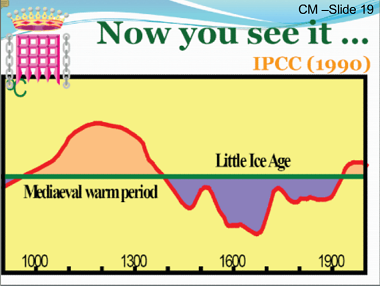 Monckton is Chief Policy Adviser at the Science and Public Policy Institute (SPPI) and is well-known as a critic of anthropogenic global warming. (See one of Monckton’s slides referenced by Abraham, to right.)
Though long (it’s a 73-minute Flash presentation with voiceover), Abraham’s critique of Monckton is well worth reviewing, especially if you’ve been wondering about the emerging criticism of AGW and the general scientific consensus on climate change.
[Update added 16 July 2010]: A reader (see his comment below) has kindly pointed me to Monckton’s response to Abraham’s presentation. This is in PDF format and is very long — his answer is in the form of a series of questions (500 of them). See “Response to John Abraham, by Christopher Monckton.”
I have to say that, although I tend to agree with the consensus position in this case, just because most or even all of the experts in a certain field believe the same way, I don’t think others should be obligated to follow the crowd. And those who do accept the consensus point of view should be willing to keep their convictions on the table and to re-examine matters when new information becomes available.
To say that those who question claims of climate-change are “anti-science” or to call them “deniers” (as if their challenges were somehow akin to denials of the Holocaust) is disingenuous and counter-productive. It gets people arguing about all the wrong things, instead of communicating and working on problems.
In the case of the challenges to the climate-change consensus, science itself is not being called into question. The real issues have to do with things like politics, public policy, economic philosophy, and ideology. If people’s livelihoods and the well-being of their descendants are in play, isn’t it reasonable to allow them to call into question the conclusions and policy implications of those who evoke climate science as justification for their policy recommendations?
Also, it’s reasonable to point out that scientists themselves are humans with their own foibles, and while for the most part they might believe they are carrying out their work according to well-established principles and sound procedures, some of them have shown themselves to be influenced by self-interest, greed, and ideological leanings. So if their work is financed with public resources and being used to influence policy, isn’t it reasonable to expect their work – and especially their statements about its implications – to stand up to public scrutiny?
If researchers and institutions are convinced that anthropogenic global warming is a real danger, then it would behoove them to find ways to present the evidence in an accessible way, rather than just sticking their noses in the air and spouting arrogant put-downs of those that raise questions.
That brings me to the value of John P. Abraham’s presentation.
 I found Abraham’s presentation reasonable and level-headed (see one of his slides to right). He refrains from personal attacks. Abraham analyzes Monckton’s scientific references, charts, and assertions in detail. Where available, he examines the data sources for Monckton’s charts and the papers he references. He even wrote to the authors of many of the original papers to ask for clarification when needed and shows their replies in his presentation.
Abraham’s presentation is really produced as a point-by-point refutation of Monckton, but along the way you learn a lot about climate change and the associated data. Pretty easy to follow, for a non-specialist reader with a fair understanding of science.
“My goal,” he says, “is to show people how they can learn about the scientific understanding on their own.”
The questions he addresses include:
If these kinds of questions concern you, I encourage you to review Abraham’s presentation.
AB — 29 June 2010
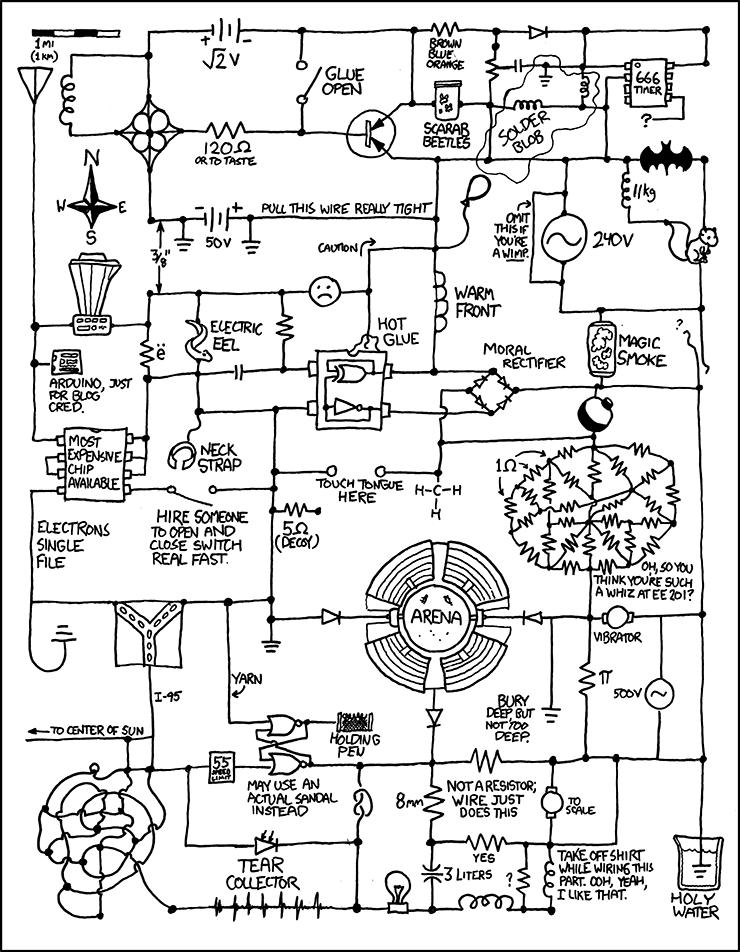
For those of us who love circuit diagrams, here’s one from stick-figure cartoonist xkcd (click on this image to see the original and larger version):
AB — 21 April 2010
The Daily Show has aired a nuanced and sensitive treatment of the anguish and prejudice experienced by those who who have chosen an alternative ordnance orientation:

AB — 13 April 2010
Here’s a clever presentation from Dorling Kindersley Books, a division of Penguin Publishing, with a message about young people’s supposed non-interest in print media. Be sure to keep watching to the halfway point, when the message takes a 180:
AB — 17 March 2010
Recently I discovered Wondermark, a comic strip remixed from old woodcuts and other art by artist David Malki. What makes Wondermark so entertaining is the juxtaposition of 19th-century artwork and 21st-century dialogue.
Wondermark comes out on Tuesday and Fridays. Today’s strip is a hilarious example (linked):

Malki describes his art sources:
Wondermark is created from 19th-Century woodcuts and engravings, scanned from my personal collection of old books and also from volumes in the Los Angeles Central Library. Most of the books are bound volumes of general-interest magazines such as Harper’s, Frank Leslie’s and Punch, but my collection also includes special-interest magazines such as Scientific American, Sears-Roebuck catalogs, storybooks, and primers.
AB — 26 January 2010
Here’s a hilarious commercial featuring an alien with a lovely British accent describing how his life has changed since he switched from eating people to Raisin Bran Crunch. A good illustration of how commercial ads can go viral!
AB — 11 December 2009
My brother, the writer Jeff Bredenberg, kindly gave me permission to publish these lines of verse disparaging the necktie:
By Jeff Bredenberg
I think that I shall never spy
A garment sillier than a tie.
A silky flag to catch the breeze,
A rag to snag my every sneeze,
A sickly cloth of polka dots: mustard drops
and ice cream blots.
And when my dangling finery
Gets tangled in machinery,
I’ll lose my breath for sake of dress
And meet my death by printing press!
If fashions fade the whole year through,
Why, oh why, can’t ties die, too?
*
— Jeff Bredenberg
This poem was originally written for the book “How to Cheat at Cleaning,” and It is dedicated to the memory of my father, Paul A. Bredenberg, who detested ties.)


 A Thinking Person, a.k.a. Cogit8R