Innovation in online direct response copywriting

I’ve long been a fan of the “long copy” approach to direct response copywriting and have done a lot of it — mostly for postal direct mail projects, but for some online projects as well.

The idea is that in direct marketing a longer sales letter is usually better than a short one. Long copy gives you more space to sell the product — with the caveat that you actually have to have something useful and compelling to say!

Most of the sales letters I have written were four pages, although I have seen some great letters of 12 pages or even longer.

Today I was especially impressed to see a landing page created for Power4Home, a business started by solar-energy entrepreneur John Russel. The page makes great use of web graphics and incorporates embedded video in a very effective way, I think. See the landing page here:

“Who Else Wants To Create Their Own Electricity And Laugh At Rising Energy Prices While Saving The Environment And Having The Electricity Company Pay You?”

I don’t know anything about the product being advertised — just wanted to comment on the marketing being used. If you’re interested in the topic of do-it-yourself solar power, the blog DIY Solar Homes offers some guidance, as well as reviews of some of the books and information products on the topic, including Power4Home.

AB — 18 June 2009

Lenses and Levers

A couple of years ago while working on a project. I thought of the idea of “lenses and levers” as a simple but valuable way of thinking about organizational development tools. At the time, I just noted it down on the outside of the project file folder (I’m cleaning out old files today) and thought I should capture it in a more permanent location.

“Lenses” are methods and tools that allow you to view and understanding what’s going on in the organization. Reports, surveys, metrics, analytics, and dashboards are examples in this category, as well as more qualitative approaches like ethnographic research.

“Levers” are tools that allow you to alter or control what goes on in the organization. These might include governance, strategic planning, management, training and development, communications, and incentives.

AB — 29 May 2009

Great life advice: Write stuff down

On Hoovers World today, Gary Hoover published a great bit of life advice (or call it a lifelong “best practice,” if you want to couch it in businessspeak). His advice is deceptively simple:

Write everything interesting down.


If you don’t know who Gary Hoover is, you probably should. It would be ‘way oversimplifying him to say he’s a serial entrepreneur, but that’s one easy way to put it. Gary is the founder of the superstore Bookstop (later purchased by Barnes & Noble) and the Hoovers business information service (now owned by D&B).

Lately I have been enjoying his Hoovers World blog because he is a voracious consumer of books and writes excellent and useful reviews of extraordinary books I have never heard of.

But today he published the entry “Two Small Practical Tips That Could Change Everything For You,” which included the advice to write down everything interesting that comes your way.

I started doing this about 20 years ago as a result of reading the wonderful little book “A Technique for Producing Ideas,” by James Webb Young. I have found that I never know when a useful idea, large or small, will come my way, whether from the external or the internal world. So I always carry a pen and pocket-sized pad with me, so I can capture information or ideas even when I am not in front of my computer. (I also never buy a shirt that does not have a pocket.)

One of the most interesting things Gary says in today’s entry, though, is that you might not ever need to actually read what you have written down:

I don’t care how smart you are or how good your memory is, 80-90% of all the good ideas you hear or think of in your life will slip right through your fingers if you do not write them down.

You do not even have to go back and re-read them; the kinetic process of having the idea flow through your mind and down your fingers through the pen onto the pad has a significant impact on your memory. [Underlining mine.] Of course, you can always reread them if you want or need to.

I also find that writing stuff down – from the book recommendations of friends to music I want to buy to business ideas I have while walking down the street – takes a burden off me. I can forget about it, I know the thought or information is securely stowed away.

I have found this point about memory retention to be true as well, and have found that what leads to even greater retention is making my notes in visual form — also know as idea mapping — see my previous blog entry “Doodling is good for thinkers.”

As a result, I seldom use lined paper for any purpose other than financial tasks. When I am planning, taking notes in a meeting, preparing an outline for public speaking, leading a group process, or just thinking, I use an unlined sketch pad or a white board to give myself space to lay out the idea I’m working with and to go in multiple directions on the page if I need to. I have even purchased custom-made pocket pads without lines on them — it’s not hard or expensive to do this through the printing department at any of the large office superstores.

Oh yes, you might have noticed that Gary’s post mentioned “Two Small Practical Tips That Could Change Everything For You.” The other tip is also simple, and maybe deceptively so, as with the first. The second tip is:

Smile


AB — 25 May 2009

Global collaboration produces a beautiful cover of “Stand by Me”

The organization Playing for Change is producing music videos by inviting artists worldwide to record accompaniments to a base track, then mixing their tracks together. The effect is like a more polished version of the remix “The Mother of All Funk Chords,” which I reported on previously.

One nice feature of the Playing for Change videos is that each artist or group is recorded in his or her own environment, mostly outdoors, so you really get a beautiful international flavor in the videos.

Here’s a great version of Ben E. King’s “Stand by Me” that they’ve done:

AB — 28 April 2009

Crisis Crowdsourcing: Harnessing Mass Collaboration to Cope With Emerging Crises

The wave of post-election violence that enveloped Kenya early in 2008 has given rise to a new movement that uses crowdsourcing to provide real-time reporting on unfolding crises.

Ushahidi.com, a project spearheaded by a group of African bloggers and software developers, is creating an open-source platform “that allows anyone around the world to set up their own way to gather reports by mobile phone, email and the web — and map them,” according to the organization.

Ushahidi, which means “testimony” in Swahili, began as a web site during the crisis in Kenya. According to Megha Bahree, writing for Forbes (see “Citizen Voices“), Ushahidi began when Ory Okolloh, a Harvard-educated lawyer and blogger living in Johannesburg, South Africa, went home to Kenya in late 2007 to vote in her country’s elections.

When riots and looting erupted in response to alleged corruption in the election process, conventional news media “went black for three days,” writes Bahree. During that time, though, Okolloh continued to blog and to receive reports from around the country from multiple sources, including journalists and government sources.

The stream of information coming to her reached such a volume that she appealed to tech-oriented contacts to assist with converting the stream of reports into a map-based visual form, a mash-up of reports of violence using Google Earth. The following gives an idea of the original mashup presentation on Ushahidi.com:
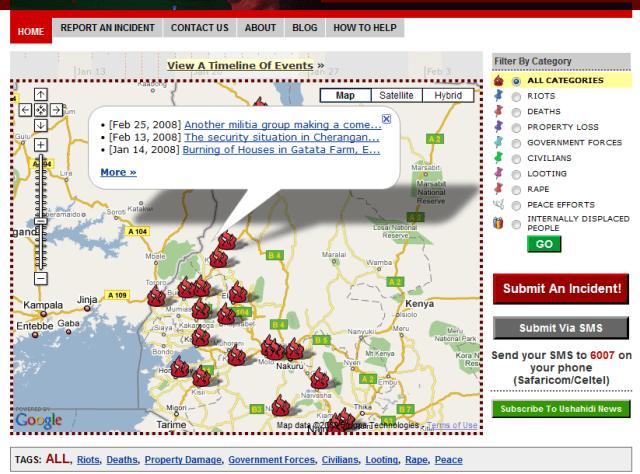
 

ushahidiscreen


Speaking in a February 2009 TEDTalk, Erik Hersman, one of the builders of Ushahidi, describes the application as “a system that would allow anyone with a mobile phone to send in information and reports on what was happening around them.” (See “How texting and GoogleMaps helped Kenyans survive crisis“)

Since mobile phones are increasingly available in Africa, Hersman says they make a good “common denominator” as a way for on-the-scene reporters to contribute to an overall view of what is happening during a crisis situation, such as a tumultuous political event, an armed conflict, or a natural disaster.

Hersman says that in the wake of the Kenya crisis, the Ushahidi group decided they needed to do more: “We needed to take what we had built and create a platform out of it so it could be used elsewhere in the world.”

Since then, the platform has been used by Al-Jazeera in Gaza, in the Democratic Republic of Congo, in South Africa to “map xenophobic attacks perpetrated against non-South Africans,” according to Ushahidi, and is now being used in India to monitor that country’s general elections.

However, the “next big thing,” Hersman believes, has to do with coping with information overload and evaluating the accuracy of reporting during crises:

What we’re finding out is that we have this capacity to report eyewitness accounts of what’s going on in real time — and we’re seeing this in events like in Mumbai recently — where it’s so much easier to report now than it is to consume [the reporting].

There’s so much information, what do you do? … How do you decide what is important? What’s the veracity level of what you’re looking at? … we find that there’s this great deal of wasted crisis information. Because there’s just too much information for us to actually do anything with right now.

During the initial hours when a crisis breaks out, says Hersman, a great deal of information can be streaming out of the crisis area — in the form of mobile messages, blogs, web postings, emails,or  Twitter messages. But the world outside the crisis zone, and indeed the citizens inside it, have no way to aggregate and process the extreme volume of reporting, as well as to evaluate the accuracy and truthfulness of it.

Hersman’s group is now working on a filtering process and technology that will “take the crowd and apply them to the information,” using peer ratings to evaluate, refine, and weight the reliability of data coming out of a crisis zone — “so that we have a better understanding of the probability of something being true or not.”

One key application of the Ushahidi crowdsourcing platform is to help relief organizations assess the situation in a crisis zone in real time and direct aid to the area as quickly as possible. “The idea is to get immediate attention and relief to strife zones, and fill the gap left by news organizations that have slashed their foreign bureaus,” writes Bahree in her Forbes article. She relates one experience of how this worked during the Kenya crisis:

A ranger in Bogoria (northeast of Nairobi), William Kimosop, was driving to check on a remote outpost one evening in January when he stumbled across several hundred women, old people and children, lost in a ravine as they fled their villages where the men were still fighting. Four babies were born in that ravine, and supplies were running out.

There were no government officials or police around. He sent a text message to a friend in Nairobi, asking her to get help from aid agencies. The friend forwarded his plea to a few people, after which it got picked up by Ushahidi and within six days a Red Cross truck reached him.

AB — 22 April 2009

Behind Tropicana’s failed re-brand

Natalie Zmuda, writing for Advertising Age, says that Tropicana’s full-reverse on its new branding for its Pure Premium orange juice line was surprisingly quick. “Beverage experts were hard pressed to think of another major brand that had pulled the plug on such a sweeping redesign as swiftly as Tropicana,” she writes. (See “Tropicana Line’s Sales Plunge 20% Post-Rebranding,” April 2, 2009.)

Her article gives some of the sales figures behind the reversal: “After its package redesign, sales of the Tropicana Pure Premium line plummeted 20% between Jan. 1 and Feb. 22, costing the brand tens of millions of dollars.”

At a press conference in January 2009 by Pepsico (owner of the Tropicana brand), Peter Arnell, CEO of Arnell Group, the branding agency that executed the redesign, explained his rationale (See Ad Age’s video of the press conference here):

We thought it would be very important to take this brand and bring it or evolve it into a more current or modern state … Historically, we always show the outside of the orange. What was fascinating was that we had never shown the product called the juice. There was a strong drive to bring a big messaging onto the carton where the biggest single billboarding was.

I think it was in the billboarding where Arnell failed. The instant I saw the two carton designs side-by-side, my first thought was, ‘The new one looks like a store brand.’:

Really, which one of these designs does a better job of billboarding? On the new carton, every color has been drained out (except the cute new squeeze-cap, which Pepsico will be retaining), and the new font looks almost generic.

It makes me wonder what kind of testing Arnell did with this new design. I would think one important part of the process would be to stock a supply of the new package design in an actual grocery-store cooler or shelf to see how well it stands out against the competition.

For a good example of on-the-shelf billboarding, take a look at this cereal aisle:

specialkht-001

See how Special K stands out on the shelf? The packaging does it.

In one of our ILO Institute reports (“Best Practices for CPG Design Teams”), we commented on the contribution packaging can make toward getting the attention of shoppers in the store (we used this same photo in the report):

As an example of simple visual differentiation through packaging, we note that Special K achieves high visibility on the retail shelf with standard package sizes using one simple graphic technique – making sure that on the front of every package is a big red “K” with a mostly white background. This emphasizes Kellogg’s offering by placing a distinct swath of giant “Ks” across the cereal aisle.

We also used the following example from spice company McMillan:

mcmillanshelf

In our report, we commented:


McMillan’s shelf dispensing system achieves strong visual emphasis for its spice products. In the case of the display shown here, McMillan’s has even gotten the retailer to agree to alter its shelving configuration to accommodate the dispensing system.

This emphasizes the importance of including on the product design team members who are knowledgeable about the retail destination of a new product and the restrictions likely to be encountered in the store.

One positive aspect of the Tropicana re-branding debacle is that we analysts now have another negative case study to refer to!

AB — 3 April 2009


The Hole in the Wall: Computing for India’s Impoverished

Below is a blog entry I posted a few years ago when I was working for TMCnet. I wanted to refer to it in an upcoming post, but it has disappeared from the TMCnet web site.

Transferred over on 31 March 2009 from Al Bredenberg’s VOIP & CRM Blog (linking here to the Wayback Machine’s archived version):

VoIP for the Developing World

Rich Tehrani wrote a fascinating blog entry today about the potential connection between MIT’s $100-laptop program and the future possibilities for VoIP in developing countries. See his essay at:

VoIP Helps the Needy

In part, Rich writes:

… imagine if there was a way to get computers into the hands of more children. What would this do for the world’s developing nations and how would it help children? Imagine they would now be able to compute inexpensively and have access to the Internet and also speak for free with others.

This is a huge deal because in many parts of the world there aren’t telephones or even telephone lines. Many children don’t even understand the concept of the telephone. What if we could get them to access the web, allow them to compose documents, blog and talk for free? What an amazing world that would be. What an exciting place to live. What a more interconnected planet we would live on.

This reminds me of the fascinating story of “The Hole in the Wall,” which I heard about a couple of years ago.

Sugata Mitra, a computer scientist in India, decided to place a computer with a high-speed Internet connection in a hole in the wall that separated the high-tech company he worked for from the slum next door. He found that the kids from the neighborhood, who had never seen a computer, very quickly figured out how to use it and how to perform complexe tasks over the Internet. The last I heard, he was institutinga program making public-access computers available in poor neighborhoods in many areas of India.

One of the incidents I recall from the story was that a reporter asked one of the kids how he learned to use a computer so well, and the kid answered, ‘What’s a computer?’

AB — 10/3/05

SixthSense prototype portends “The Internet of Things”

Today I learned about SixthSense, a wearable gestural computer interface developed at MIT’s Fluid Interfaces Group, a research group devoted to the design of interfaces that are “more immersive, more intelligent, and more interactive.”

Here’s how the group describes the interface:

The SixthSense prototype is comprised of a pocket projector, a mirror and a camera. The hardware components are coupled in a pendant like mobile wearable device. Both the projector and the camera are connected to the mobile computing device in the user’s pocket. The projector projects visual information enabling surfaces, walls and physical objects around us to be used as interfaces; while the camera recognizes and tracks user’s hand gestures and physical objects using computer-vision based techniques.

These images give you an idea how the prototype works and the kind of functionality it presages:


Here’s a link to a video that shows some great demos of SixthSense.

Fluid Interface Group’s work makes me think of one of the best film portrayals of a futuristic computer interface: the one Tom Cruise uses in the film Minority Report. In the movie, Cruise’s character uses virtual-reality gloves to manipulate a large interface virtual interface in front of him — very exciting to see.

This work of the Fluid Interface Group touches on the “Internet of Things,” an idea I first heard put forward by the Auto-ID Labs, a group working in the area of networked RFID. One of our ILO Institute reports on new directions for RFID discussed some of the possibilities for this Internet of Things:

If miniature Web pages and servers could be embedded in building materials, components of vehicles and aircraft, furniture, appliances, apparel, and other places, this could have huge implications for marketing, communication, and provision of services, not to mention changing the very nature of the world around us.

MIT’s Sanjay Sarma tells ILO researchers that this Internet of Things is “going to have a huge impact,” and that RFID is one of the key enabling technologies. He points out that RFID creates a greatly increased connection between the physical world and the world of information by connecting more data to physical things and transferring it at much greater speeds in much greater volumes. “We used to connect data to the physical world through keyboards, but there’s only so much data you can get in through the keyboard. But with RFID it’s automatic and it’s happening all the time.”

Sarma says that the Internet of Things will allow you to “have control in your enterprise in a way that is completely unprecedented.” Sarma calls this control “high-resolution management—management with eyes everywhere, as opposed to management by gut reactions and guesswork.”

The high volume and extreme complexity of this Internet of Things presents unique opportunities and challenges for the technology provider. “If you are in this market,” says Sarma, “you should be looking more and more at distributed computation, and you should be looking at embedded computations, at areas related to distributed software, at software related to data acquisition, and at software related to process change. They’ll all be changing in the next ten years.”

(“Directions for New RFID Initiatives,” ILO Institute, Aug. 23, 2006)

AB — 17 March 2009

Best argument for remixing: Watch this video

Just today I saw a video that is probably the best argument I have ever seen in favor of remixing. Please watch and listen to Mother of All Funk Chords. Fantastic!

Here the author explains how he makes his remixed music videos.

If you prefer an intellectual argument over an experiential one, see this video lecture by Stanford law professor Lawrence Lessig. Lessig has spoken at some of our meetings at the Institute for Innovation in Large Organizations (ILO). See Lessig’s blog here.

Lessig is probably the best thinker around remixing and interesting to listen to. But watching Mother of all Funk Chords is a lot more fun.

AB — 10 March 2009

Bionic eye is restoring sight for blind

BBC is carrying an interesting story today about some initial successes in trials of a bionic eye — see “Bionic eye gives blind man sight.”

Moorfields Eye Hospital in the UK is carrying out trials of the technology with three patients suffering from retinitis pigmentosa, an inherited disease that causes retinal degeneration. Eighteen patients around the world are participating in trials.

The bionic eye is able to send “meaningful visual stimuli” to the brains of patients, according to a retinal surgeon.

As an example of what it can do, one patient quoted in the BBC article says the device allows him to sort light from dark laundry.

Here’s a video that gives an idea how the technology works.

AB — 4 March 2009