If, like me, you’re fascinated by cutaway illustrations, you should take a look at the posters of nuclear reactors created at BibliOdyssey. Here’s a sample (this is a linked image — click through to see it in full size):

AB — 20 December 2009

If, like me, you’re fascinated by cutaway illustrations, you should take a look at the posters of nuclear reactors created at BibliOdyssey. Here’s a sample (this is a linked image — click through to see it in full size):
AB — 20 December 2009
One of the great challenges for an observer of public discourse these days is getting a clear, unbiased statement of both sides of an argument. People have powerful motivations to articulate only their opinion and trash the other side — see my previous entry, “Spin and Rhetorical Intimidation.”
So it was refreshing to come across the infographic linked below from Information Is Beautiful. The graphic provides a reasonable, neutral juxtaposition of both sides in the climate debate. (Click the image to see it full-size.)

AB — 8 December 2009
Reading Andrew Robinson’s fascinating book Lost Languages: The Enigma of the World’s Undeciphered Scripts (2002, McGraw-Hill), I recently learned the amazing story of the decipherment of the Linear B script by amateur philologist Michael Ventris in the 1950s.
The story brings home some important lessons about innovation:
Linear B is a script discovered on the island of Crete by archaeologist Sir Arthur Evans. Evans never deciphered Linear B, as he had fallen too much in love with certain precious ideas, chiefly his belief that the culture he had uncovered through his excavations at Knossos was a great noble civilization (which he called “Minoan”) that had dominated the Aegean in ancient times.
As it turned out, Linear B was a syllabic script used to write ancient Greek. However, the decipherment of the script was delayed by many decades because Evans was reluctant to share the inscriptions with other scholars.
When death finally wrested the inscriptions from Evans’s hands in 1941, other scholars were able to begin a concerted effort at decipherment.
Although it was Ventris’s genius primarily that cracked the script, he didn’t do it alone, which is a crucial point.
Although a brilliant scholar with a lifelong fascination for Linear B, Ventris was in fact not a professional philologist or linguist.
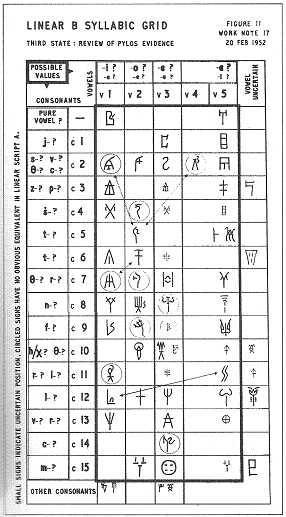 Ventris was an architect, and I think his architectural training, discipline, and practices were an important contributing factor in his success with Linear B.
It’s interesting to note that Ventris’s grid-based system for decipherment is reminiscent of the schedules architects use to lay out information in their drawings.
But more important for Ventris’s success with Linear B was his value of collaboration, also an important architectural practice.
Robinson quotes classicist Thomas Palaima describing Ventris’s practice of “group working, hypothesizing and brainstorming” and adds that
In other words, he did not believe in the idea of the genius who works solo and finally solves a problem by his own sheer unaided brainpower …
Ventris explained in writing and in tremendous detail each stage of his attack on Linear B, and then circulated these neatly type “Work Notes” (Ventris’s name for them) to other scholars for comments and contradictions.
Much of what he hypothesized turned out to be irrelevant or wrong, but this did not stop him from showing it to the professionals. And it appears that he did take this whole approach from his work as an architect.
To me this stresses the immense value of multi-disciplinary teams, cross-fertilization, and collaborative approaches in all kinds of innovation work.
Also important was Ventris’s humility and willingness to recognize his own errors, in contrast to Evans’s stubborn insistence on his Minoan theory.
Ventris and other scholars had for a time favored the idea that Linear B was used to write the Etruscan language. However, after it became evident that the Linear B language was Greek, writes Robinson,
… in a measured and slightly diffident voice [Ventris] announced his discovery on BBC radio, publicly renouncing his long-cherished Etruscan hypothesis … As John Chadwick much later said of Ventris: “The most interesting fact about his work is that it forced him to propose a solution contrary to his own preconceptions.”
This is a worthy example for all experts, who are far too inclined to hop on a particular hobby-horse and just keep on riding it for their entire careers.
These lessons bring to mind some research that we have done at the Institute for Innovation in Large Organizations in the area of cross-functional teaming, a valuable process for innovation work.
(Most of our reports are limited-circulation and confidential. However, we do sometimes quote them as I will do here, and a few of our reports are available on request.)
Here are some points on the value of team diversity in product design from one of our reports:
Bringing people from many disciplines and functions together in design teams offers great potential as a strategy to produce innovative products. However, such diversity also lays the groundwork for conflict. Thus team leaders and company management need to manage team diversity so all members can be effective and make their contribution.
Mitzi Montoya, Zelnak Professor of Marketing at North Carolina State University (NCSU) and executive director of the Services and Product Innovation Management Initiative at the school, says that companies need to recognize the likelihood of conflict and miscommunication and “put processes in place that will manage that inevitable consequence.” The problems that arise from team diversity “have to do with how the organization is structured, who those people report to. It often has nothing to do with the project itself.”
Bob Pagano of Red Sky Insights points out that diversity can bring value to the product design process by putting blue-sky innovators in the same room with more hard-nosed practical players.
You’re going to have some people around the table who are really creative and are going to look at the assignment with a really open mind. You want to have some very creative people early on who might see something outside the normal way of doing things. If they say something really bizarre, we don’t necessarily want to discourage that.
But you also need some enforcers, the ones who are going to put up the barriers, the ones who will push back, but trying to reach a common ground. They might say, ‘Well, that’s interesting. Let’s see if we can do that within the rules on the retail end.’ It’s kind of a give and take to see that nothing gets overlooked.
In our ILO report, we also found that, aside from their contributions from a functional perspective, individual team members contribute different personal qualities to the life and work of a product design team. These different characteristics can offer value in unique ways and can come into play at different stages in the process:
Innovation consultant Stephen M. Shapiro, previously an Accenture consultant, believes that it is important to “understand the various innovation styles of team players” to make use of their distinctive strengths.
Speaking with ILO researchers, Shapiro explained how he classifies these styles:
Analytical people tend to be more focused on intellectual activities and often find flaws in everything.
Structured people want to know the plans and how things will be carried out. They also are a bit more critical but are more action oriented.
Creative individuals are cerebral yet like to think broadly. They are enthusiastic and generators of new ideas. But they are often poor at implementation.
Relationship-oriented people are needed to get anything done as they can engage the organization. But they often are too focused on consensus, which is a barrier to innovation.
Shapiro believes that “once people understand their styles and the associated strengths and weaknesses, they can be more effective in how they work together.” In his view:
The innovation process goes from analytical—define the problem . . .
to creative—define solutions . . .
to structured—define plans . . .
to relationship-oriented—engage the organization.
Thus, the various players’ personal styles can come to the fore at different stages of the group’s work.
But do team diversity and cross-fertilization translate into financial results?
Our work on this report suggested that that less diverse teams tend to produce better financial results overall than highly diverse teams. However, if the company is seeking high-value breakthrough results, it is more likely to achieve those through greater diversity in design team membership:
Lee Fleming, business administration professor at Harvard Business School, writes in Harvard Business Review that highly diverse, cross-disciplinary innovation teams introduce certain risks (“Perfecting Cross-Pollination,” September 2004). After researching 17,000 patents, he believes that
The financial value of the innovations resulting from such cross-pollination is lower, on average, than the value of those that come out of more conventional, siloed approaches. In other words, as the distance between the team members’ fields or disciplines increases, the overall quality of the innovations falls.
However, he adds a big but:
But my research also suggests that the breakthroughs that do arise from such multidisciplinary work, though extremely rare, are frequently of unusually high value—superior to the best innovations achieved by conventional approaches.
Fleming comments that “when members of a team are cut from the same cloth,” as with a group of all marketing professionals, “you don’t see many failures, but you don’t see many extraordinary breakthroughs either.”
However, as team members’ fields begin to vary, “the average value of the team’s innovations falls while the variation in value around that average increases. You see more failures, but you also see occasional breakthroughs of unusually high value.”
AB — 21 Nov. 2009
Normally I steer away from hip-hop, but this collaboration between Tom Waits and Kool Keith was weird enough and fascinating enough to take note of. Gives you an idea what Tom Waits might look like if he was a scary cartoon monster (he already has the voice anyway):
AB — 19 Nov. 2009
Zuzu.com yesterday carried a story about what has to be the world’s largest treehouse — 97 feet high and 11 stories — see “The World’s Greatest Treehouse.” The treehouse was built by Horrace Burgess in Crossville, Tennessee. The article includes many stunning photos.
Here’s one of the photos, linked from Zuzu:

AB — 27 Oct. 2009
For fiction authors who are having trouble pigeonholing their series:
Cartoonist David Malki has created a very useful and artistic Genre-Fiction Generator on his Wondermark art blog — see “The Electro-Plasmic Hydrocephalic Genre-Fiction Generator 2000.”
AB — 5 Oct. 2009
Ever since Stanford Professor Larry Lessig spoke about remix (among other intellectual-property topics) for us at the ILO Institute a couple of years ago, I’ve been fascinated by the subject and have watched out for particularly creative examples.
Yesterday I commented on a new one I’ve found called “Auto-Tune the News.”
However, my favorite example remains “The Mother of All Funk Chords” — a great music mix that brings together clips from across geographies and cultures and age-groups — and across decades of time:
AB — 3 Sept. 2009
I find that the discussion around the Intelligent-Design controversy is often clouded by rhetorical spin from one side or the other. I thought this brief note from William Dembski captured the central issue clearly: See “Evolutionary Informatics as Intelligent Design and not as Theistic Evoluation.” See also my previous entry, “Spin and Rhetorical Intimidation.”
AB — 24 August 2009
Ran across this crazy, exciting art print just released by Jim Flora Art. If I was flush right now, I would consider shelling out the $175:

James Flora lived 1914-1998, and was known for his jazz album covers and children’s books. Looking at the Flora web site, I would say the family is doing a great job of marketing his art.
AB — 21 July 2009
 I read today in John Blossom’s ContentBlogger about Daylife, provider of content-development and -management applications that allow a publisher to create instant content portals — see “Life With Daylife: On-Demand Feature Content Development Grows Up.”
Blossom says Daylife permits a publisher to quickly put together content, marketing, and advertising resources from both internal and external sources. He believes this kind of toolset can allow publishers to duplicate the Huffington Post‘s successful integration of marketing elements and editorial content.
Daylife describes its management interface as simple and intuitive, designed for non-technical editorial personnel for point-and-click interaction.
It seems to me that the Daylife model offers a useful option for news organizations that are struggling to find a new and workable business model. Blossom says,
[A] service like Daylife cannot replace all of the editorial value of a traditional newsroom and more robust editorial content development platforms, but when it can provide most of the robust functionality that people expect from an online publication today along with access to deep and high-quality content, it’s time for publishers to think more actively about how they can use tools such as Daylife to enable their content to succeed in any number of topic-specific “instant portals” and other efficiently managed content presences far more actively.
AB — 21 July 2009
 A Thinking Person, a.k.a. Cogit8R