Rob Hopkins Response to Criticism of Environmentalism

My article this week at ThomasNet Green & Clean was on the fascinating, fast-growing Transition movement — see “The Transition Movement – Preparing for a World After Peak Oil.”

The “green movement” that seemed so powerful and dynamic just a couple of years ago has come under criticism recently, as you can see in Susanna Rustin’s recent article in the Guardian — see “Has the green movement lost its way?

Coincidentally, the Transition Network just concluded its 2011 conference in Liverpool. Co-founder Rob Hopkins wrote up his reflections on the conference in a blog post yesterday, and included a response to Rustin’s question:

An article in the Guardian last week asked “has the green movement lost its way?” I think that is the wrong question. The right question should be “has a new, emergent culture which embraces resilience and localisation, equity and partnership, even scratched the surface of its potential?” I think the answer is a resolute no. We’ve all had a taste of that this weekend.

Having written a great deal about innovation as analyst for the ILO Institute, insights like this get my attention. Innovations often come from unexpected quarters, when people begin asking new questions and asking questions in a different way.

AB — 12 July 2011

Integrating Wind and Solar Energy: German Virtual Power Plant Shows How to Do It

German Combined Power PlantOver at ThomasNet Green & Clean today, I’ve written about a groundbreaking pilot project called the Combined Power Plant. See the article, “German Combined Power Plant Demonstrates Real-Time Integration of Renewables.”

What these scientists are doing is using networking technology to integrate 36 separate solar, wind, and biogas installations into one “virtual power plant.” Combining multiple sources like this allows them to balance out the various sources, solving a key problem in the integration of renewables into the electric grid.

AB — 27 June 2011

Can The Economy Keep Growing Without Destroying the Planet?

Over at ThomasNet Green & Clean earlier this week, I explored the topic of “Decoupling” as it applies to economic growth and its connection to environmental damage and the depletion of resources — see “Decoupling: Can Humanity Prosper Without Plundering and Poisoning the Planet?

The write-up extracts the essence from a report by the United Nations Environmental Programme (UNEP). The authors lay out the basic argument and data for decoupling. The report’s authors believe that innovation is the answer:

Innovation now needs to be harnessed for resource productivity and environmental restoration… innovations that contribute to decoupling through reducing environmental pressure and contributing to sustainability during economic activities.

AB — 10 June 2011

Why People Don’t Believe Scientists Even When There Is ‘Consensus’

An interesting study, soon to appear in the Journal of Risk Research, by Yale law professor Dan M. Kahan and colleagues, suggests that people tend to disbelieve scientists whose cultural values are different than theirs.

I’m not able to determine when this study will be published, but you can find an abstract at this link, and I was able to download a preliminary version of the whole article in PDF by clicking on the link on that page that says “One-Click Download.”

These conclusions shed light on the debate over anthropogenic climate change, Kahan tells Science Daily (“Why ‘Scientific Consensus’ Fails to Persuade“):

We know from previous research that people with individualistic values, who have a strong attachment to commerce and industry, tend to be skeptical of claimed environmental risks, while people with egalitarian values, who resent economic inequality, tend to believe that commerce and industry harms the environment.

(For more on the climate-change controversy, see my previous entry, “John Abraham’s Point-by-Point Rebuttal of Climate-Skeptic Monckton.”

Kahan and colleagues based their study on the theory of the cultural cognition of risk. In his paper, Kahan says this theory “posits a collection of psychological mechanisms that dispose individuals selectively to credit or dismiss evidence of risk in patterns that fit values they share with others.”

The researchers surveyed a representative sample of 1,500 U.S. adults. They divided this sample into groups with opposite cultural worldviews, some favoring hierarchy and individualism, the others favoring egalitarianism and communitarianism.

They surveyed the respondents to determine their beliefs about what in fact is the scientific consensus on issues of climate change, disposal of nuclear waste, and concealed handguns, with particular focus on the associated levels of risk in each of those areas. Various statements were attributed to fictional personas portrayed as authors of books on these various issues. Respondents were asked to judge whether each author is really an expert or not.

Analysis of the results on the climate-change issue revealed that:

Disagreement was sharp among individuals identified (through median splits along both dimensions of cultural worldview) as “hierarchical individualists,” on the one hand, and “egalitarian communitarians,” on the other. Solid majorities of egalitarian communitarians perceived that most expert scientists agree that global warming is occurring (78%) and that it has an anthropogenic source (68%). In contrast, 56% of hierarchical individualists believe that scientists are divided, and another 25% (as opposed to 2% for egalitarian communitarians) that most expert scientists disagree that global temperatures are increas-ing. Likewise, a majority of hierarchical individualists, 55%, believed that most expert scientists are divided on whether humans are causing global warming, with another 32% perceiving that most expert scientists disagree with this conclusion.

The study revealed similar results around the issues of geologic isolation of nuclear wastes and concealed-carry laws.

So should we conclude that people are going to believe what they want to believe, and that’s all there is to it? The authors make an interesting statement about the implications for public presentation of scientific findings:

It is not enough to assure that scientifically sound information — including evidence of what scientists themselves believe — is widely disseminated: cultural cognition strongly motivates individuals — of all worldviews — to recognize such information as sound in a selective pattern that reinforces their cultural predispositions. To overcome this effect, communicators must attend to the cultural meaning as well as the scientific content of information.

The report suggests some ways that cultural meaning might be considered in communicating with the public. One such strategy is what the authors call narrative framing:

Individuals tend to assimilate information by fitting it to pre-existing narrative templates or schemes that invest the information with meaning. The elements of these narrative templates — the identity of the stock heroes and villains, the nature of their dramatic struggles, and the moral stakes of their engagement with one another — vary in identifiable and recurring ways across cultural groups. By crafting messages to evoke narrative templates that are culturally congenial to target audiences, risk communicators can help to assure that the content of the information they are imparting receives considered attention across diverse cultural groups.

AB — 24 Sept. 2010

John Abraham’s Point-by-Point Rebuttal of Climate-Skeptic Monckton

[Updated 16 July 2010]

Yesterday I reviewed an informative presentation by John P. Abraham, associate professor in the school of engineering of St. Thomas University in Minnesota. In his presentation, “A Scientist Replies to Christopher Monckton,” Abraham offers a point-by-point rebuttal/refutation of claims made in a presentation he attended by Christopher Monckton, in which Monckton presented arguments against anthropogenic (man-made) global warming (AGW), that is, the idea that human activity is causing an increase in global temperatures resulting in dangerous climate change.

Monckton is Chief Policy Adviser at the Science and Public Policy Institute (SPPI) and is well-known as a critic of anthropogenic global warming. (See one of Monckton’s slides referenced by Abraham, to right.)

Though long (it’s a 73-minute Flash presentation with voiceover), Abraham’s critique of Monckton is well worth reviewing, especially if you’ve been wondering about the emerging criticism of AGW and the general scientific consensus on climate change.

[Update added 16 July 2010]: A reader (see his comment below) has kindly pointed me to Monckton’s response to Abraham’s presentation. This is in PDF format and is very long — his answer is in the form of a series of questions (500 of them). See “Response to John Abraham, by Christopher Monckton.”

I have to say that, although I tend to agree with the consensus position in this case, just because most or even all of the experts in a certain field believe the same way, I don’t think others should be obligated to follow the crowd. And those who do accept the consensus point of view should be willing to keep their convictions on the table and to re-examine matters when new information becomes available.

To say that those who question claims of climate-change are “anti-science” or to call them “deniers” (as if their challenges were somehow akin to denials of the Holocaust) is disingenuous and counter-productive. It gets people arguing about all the wrong things, instead of communicating and working on problems.

In the case of the challenges to the climate-change consensus, science itself is not being called into question. The real issues have to do with things like politics, public policy, economic philosophy, and ideology. If people’s livelihoods and the well-being of their descendants are in play, isn’t it reasonable to allow them to call into question the conclusions and policy implications of those who evoke climate science as justification for their policy recommendations?

Also, it’s reasonable to point out that scientists themselves are humans with their own foibles, and while for the most part they might believe they are carrying out their work according to well-established principles and sound procedures, some of them have shown themselves to be influenced by self-interest, greed, and ideological leanings. So if their work is financed with public resources and being used to influence policy, isn’t it reasonable to expect their work – and especially their statements about its implications – to stand up to public scrutiny?

If researchers and institutions are convinced that anthropogenic global warming is a real danger, then it would behoove them to find ways to present the evidence in an accessible way, rather than just sticking their noses in the air and spouting arrogant put-downs of those that raise questions.

That brings me to the value of John P. Abraham’s presentation.
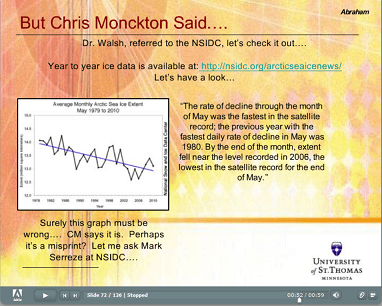
Sample slide from Abraham presentationI found Abraham’s presentation reasonable and level-headed (see one of his slides to right). He refrains from personal attacks. Abraham analyzes Monckton’s scientific references, charts, and assertions in detail. Where available, he examines the data sources for Monckton’s charts and the papers he references. He even wrote to the authors of many of the original papers to ask for clarification when needed and shows their replies in his presentation.

Abraham’s presentation is really produced as a point-by-point refutation of Monckton, but along the way you learn a lot about climate change and the associated data. Pretty easy to follow, for a non-specialist reader with a fair understanding of science.

“My goal,” he says, “is to show people how they can learn about the scientific understanding on their own.”

The questions he addresses include:

  • Has Al Gore really overestimated the future sea-level rise by 100 times, and is it really true that sea levels are not rising?
  • Are polar bears in the Canadian Beaufort Sea really endangered by warming temperatures or not?
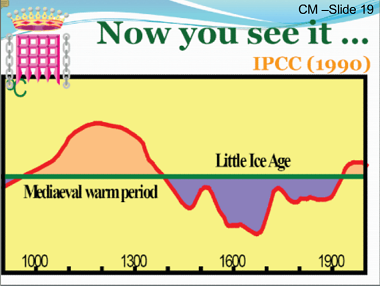
  • Was there a medieval warming period comparable to that taking place today, and did the IPCC “erase” that medieval warming period from its historical climate data?
  • Do IPCC’s climate sensitivity estimates really rest on just 4 scientific papers, rather than 2,500?
  • Have average temperatures actually been going down, contradicting IPCC projections?
  • Is there really no evidence for any catastrophic effects of anthropogenic climate change anywhere in the world?
  • Is it really true that increase in CO2 levels is an effect of warming rather than a cause, and is it really true that CO2’s effect on global temperature is negligible?
  • Is the extent of arctic sea ice actually remaining steady rather than declining?
  • Has the Greenland ice sheet really been increasing rather than decreasing?
  • Is it really true that the Himalayan glaciers have not been retreating?
  • Is it really true that oceans are not heating up?
  • Is it really true that global warming is caused by increased solar activity, rather than human activities?

If these kinds of questions concern you, I encourage you to review Abraham’s presentation.

AB — 29 June 2010

Climate Change: A great side-by-side comparison of both sides’ views

One of the great challenges for an observer of public discourse these days is getting a clear, unbiased statement of both sides of an argument. People have powerful motivations to articulate only their opinion and trash the other side — see my previous entry, “Spin and Rhetorical Intimidation.”

So it was refreshing to come across the infographic linked below from Information Is Beautiful. The graphic provides a reasonable, neutral juxtaposition of both sides in the climate debate. (Click the image to see it full-size.)

AB — 8 December 2009