Infographic: Google by the Numbers

Pingdom has put together a fascinating (and useful for innovation researchers) infographic on Google, providing details on Google’s organization, technologies, usage, finances, and more.

For example, the graphic shows us that Google allows employees to spend 20 percent of their time working on “blue-sky” projects and that 50 percent of Google’s products have resulted from that blue-sky time. 37.5 percent of the company’s employees work in R&D and 37 percent in sales and marketing. 97 percent of revenue comes from advertising.

Thanks to Boing Boing for pointing me to the infographic, which is linked here (click on the image to see it full-size):

AB — 25 February 2010

An Emerging ‘Open Source World’

The editors of Focus have created an interesting Infographic exploring the growing influence of open-source development, not just in software development, but in healthcare, science, content — even beverages (first time I’ve heard of OpenCola and Brewtopia Blowfly).

Focus is an open-source online resource for business data and research operated by media company Tippit Inc.

Here’s a link to the graphic — click through to see it full-size:

AB — 16 February 2010

Michael Ventris, the Decipherment of Linear B, and the Value of Cross-Fertilization

Reading Andrew Robinson’s fascinating book Lost Languages: The Enigma of the World’s Undeciphered Scripts (2002, McGraw-Hill), I recently learned the amazing story of the decipherment of the Linear B script by amateur philologist Michael Ventris in the 1950s.

The story brings home some important lessons about innovation:

  • Be willing and eager to collaborate
  • Take advantage of cross-fertilization by bringing in perspectives and skills from diverse disciplines
  • Fight against your personal prejudices and keep yourself open to new ways of looking at things

Linear B is a script discovered on the island of Crete by archaeologist Sir Arthur Evans. Evans never deciphered Linear B, as he had fallen too much in love with certain precious ideas, chiefly his belief that the culture he had uncovered through his excavations at Knossos was a great noble civilization (which he called “Minoan”) that had dominated the Aegean in ancient times.

As it turned out, Linear B was a syllabic script used to write ancient Greek. However, the decipherment of the script was delayed by many decades because Evans was reluctant to share the inscriptions with other scholars.

When death finally wrested the inscriptions from Evans’s hands in 1941, other scholars were able to begin a concerted effort at decipherment.

Although it was Ventris’s genius primarily that cracked the script, he didn’t do it alone, which is a crucial point.

Although a brilliant scholar with a lifelong fascination for Linear B, Ventris was in fact not a professional philologist or linguist.
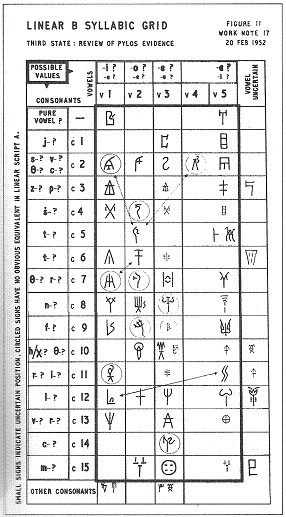
Ventris was an architect, and I think his architectural training, discipline, and practices were an important contributing factor in his success with Linear B.

It’s interesting to note that Ventris’s grid-based system for decipherment is reminiscent of the schedules architects use to lay out information in their drawings.

But more important for Ventris’s success with Linear B was his value of collaboration, also an important architectural practice.

Robinson quotes classicist Thomas Palaima describing Ventris’s practice of “group working, hypothesizing and brainstorming” and adds that

In other words, he did not believe in the idea of the genius who works solo and finally solves a problem by his own sheer unaided brainpower …

Ventris explained in writing and in tremendous detail each stage of his attack on Linear B, and then circulated these neatly type “Work Notes” (Ventris’s name for them) to other scholars for comments and contradictions.

Much of what he hypothesized turned out to be irrelevant or wrong, but this did not stop him from showing it to the professionals. And it appears that he did take this whole approach from his work as an architect.

To me this stresses the immense value of multi-disciplinary teams, cross-fertilization, and collaborative approaches in all kinds of innovation work.

Also important was Ventris’s humility and willingness to recognize his own errors, in contrast to Evans’s stubborn insistence on his Minoan theory.

Ventris and other scholars had for a time favored the idea that Linear B was used to write the Etruscan language. However, after it became evident that the Linear B language was Greek, writes Robinson,

… in a measured and slightly diffident voice [Ventris] announced his discovery on BBC radio, publicly renouncing his long-cherished Etruscan hypothesis … As John Chadwick much later said of Ventris: “The most interesting fact about his work is that it forced him to propose a solution contrary to his own preconceptions.”

This is a worthy example for all experts, who are far too inclined to hop on a particular hobby-horse and just keep on riding it for their entire careers.

These lessons bring to mind some research that we have done at the Institute for Innovation in Large Organizations in the area of cross-functional teaming, a valuable process for innovation work.

(Most of our reports are limited-circulation and confidential. However, we do sometimes quote them as I will do here, and a few of our reports are available on request.)

Here are some points on the value of team diversity in product design from one of our reports:

Bringing people from many disciplines and functions together in design teams offers great potential as a strategy to produce innovative products. However, such diversity also lays the groundwork for conflict. Thus team leaders and company management need to manage team diversity so all members can be effective and make their contribution.

Mitzi Montoya, Zelnak Professor of Marketing at North Carolina State University (NCSU) and executive director of the Services and Product Innovation Management Initiative at the school, says that companies need to recognize the likelihood of conflict and miscommunication and “put processes in place that will manage that inevitable consequence.” The problems that arise from team diversity “have to do with how the organization is structured, who those people report to. It often has nothing to do with the project itself.”

Bob Pagano of Red Sky Insights points out that diversity can bring value to the product design process by putting blue-sky innovators in the same room with more hard-nosed practical players.

You’re going to have some people around the table who are really creative and are going to look at the assignment with a really open mind. You want to have some very creative people early on who might see something outside the normal way of doing things. If they say something really bizarre, we don’t necessarily want to discourage that.

But you also need some enforcers, the ones who are going to put up the barriers, the ones who will push back, but trying to reach a common ground. They might say, ‘Well, that’s interesting. Let’s see if we can do that within the rules on the retail end.’ It’s kind of a give and take to see that nothing gets overlooked.

In our ILO report, we also found that, aside from their contributions from a functional perspective, individual team members contribute different personal qualities to the life and work of a product design team. These different characteristics can offer value in unique ways and can come into play at different stages in the process:

Innovation consultant Stephen M. Shapiro, previously an Accenture consultant, believes that it is important to “understand the various innovation styles of team players” to make use of their distinctive strengths.

Speaking with ILO researchers, Shapiro explained how he classifies these styles:

Analytical people tend to be more focused on intellectual activities and often find flaws in everything.

Structured people want to know the plans and how things will be carried out. They also are a bit more critical but are more action oriented.

Creative individuals are cerebral yet like to think broadly. They are enthusiastic and generators of new ideas. But they are often poor at implementation.

Relationship-oriented people are needed to get anything done as they can engage the organization. But they often are too focused on consensus, which is a barrier to innovation.

Shapiro believes that “once people understand their styles and the associated strengths and weaknesses, they can be more effective in how they work together.” In his view:

The innovation process goes from analytical—define the problem . . .

to creative—define solutions . . .

to structured—define plans . . .

to relationship-oriented—engage the organization.

Thus, the various players’ personal styles can come to the fore at different stages of the group’s work.

But do team diversity and cross-fertilization translate into financial results?

Our work on this report suggested that that less diverse teams tend to produce better financial results overall than highly diverse teams. However, if the company is seeking high-value breakthrough results, it is more likely to achieve those through greater diversity in design team membership:

Lee Fleming, business administration professor at Harvard Business School, writes in Harvard Business Review that highly diverse, cross-disciplinary innovation teams introduce certain risks (“Perfecting Cross-Pollination,” September 2004). After researching 17,000 patents, he believes that

The financial value of the innovations resulting from such cross-pollination is lower, on average, than the value of those that come out of more conventional, siloed approaches. In other words, as the distance between the team members’ fields or disciplines increases, the overall quality of the innovations falls.

However, he adds a big but:

But my research also suggests that the breakthroughs that do arise from such multidisciplinary work, though extremely rare, are frequently of unusually high value—superior to the best innovations achieved by conventional approaches.

Fleming comments that “when members of a team are cut from the same cloth,” as with a group of all marketing professionals, “you don’t see many failures, but you don’t see many extraordinary breakthroughs either.”

However, as team members’ fields begin to vary, “the average value of the team’s innovations falls while the variation in value around that average increases. You see more failures, but you also see occasional breakthroughs of unusually high value.”

AB — 21 Nov. 2009

Cool art print: ‘Big Evening’ by Jim Flora

Ran across this crazy, exciting art print just released by Jim Flora Art. If I was flush right now, I would consider shelling out the $175:

James Flora lived 1914-1998, and was known for his jazz album covers and children’s books. Looking at the Flora web site, I would say the family is doing a great job of marketing his art.

AB — 21 July 2009

Daylife: System for creating just-in-time content portals

Daylife cover exampleI read today in John Blossom’s ContentBlogger about Daylife, provider of content-development and -management applications that allow a publisher to create instant content portals — see “Life With Daylife: On-Demand Feature Content Development Grows Up.”

Blossom says Daylife permits a publisher to quickly put together content, marketing, and advertising resources from both internal and external sources. He believes this kind of toolset can allow publishers to duplicate the Huffington Post‘s successful integration of marketing elements and editorial content.

Daylife describes its management interface as simple and intuitive, designed for non-technical editorial personnel for point-and-click interaction.

It seems to me that the Daylife model offers a useful option for news organizations that are struggling to find a new and workable business model. Blossom says,

[A] service like Daylife cannot replace all of the editorial value of a traditional newsroom and more robust editorial content development platforms, but when it can provide most of the robust functionality that people expect from an online publication today along with access to deep and high-quality content, it’s time for publishers to think more actively about how they can use tools such as Daylife to enable their content to succeed in any number of topic-specific “instant portals” and other efficiently managed content presences far more actively.

AB — 21 July 2009

Innovation in online direct response copywriting

I’ve long been a fan of the “long copy” approach to direct response copywriting and have done a lot of it — mostly for postal direct mail projects, but for some online projects as well.

The idea is that in direct marketing a longer sales letter is usually better than a short one. Long copy gives you more space to sell the product — with the caveat that you actually have to have something useful and compelling to say!

Most of the sales letters I have written were four pages, although I have seen some great letters of 12 pages or even longer.

Today I was especially impressed to see a landing page created for Power4Home, a business started by solar-energy entrepreneur John Russel. The page makes great use of web graphics and incorporates embedded video in a very effective way, I think. See the landing page here:

“Who Else Wants To Create Their Own Electricity And Laugh At Rising Energy Prices While Saving The Environment And Having The Electricity Company Pay You?”

I don’t know anything about the product being advertised — just wanted to comment on the marketing being used. If you’re interested in the topic of do-it-yourself solar power, the blog DIY Solar Homes offers some guidance, as well as reviews of some of the books and information products on the topic, including Power4Home.

AB — 18 June 2009

Lenses and Levers

A couple of years ago while working on a project. I thought of the idea of “lenses and levers” as a simple but valuable way of thinking about organizational development tools. At the time, I just noted it down on the outside of the project file folder (I’m cleaning out old files today) and thought I should capture it in a more permanent location.

“Lenses” are methods and tools that allow you to view and understanding what’s going on in the organization. Reports, surveys, metrics, analytics, and dashboards are examples in this category, as well as more qualitative approaches like ethnographic research.

“Levers” are tools that allow you to alter or control what goes on in the organization. These might include governance, strategic planning, management, training and development, communications, and incentives.

AB — 29 May 2009

Great life advice: Write stuff down

On Hoovers World today, Gary Hoover published a great bit of life advice (or call it a lifelong “best practice,” if you want to couch it in businessspeak). His advice is deceptively simple:

Write everything interesting down.


If you don’t know who Gary Hoover is, you probably should. It would be ‘way oversimplifying him to say he’s a serial entrepreneur, but that’s one easy way to put it. Gary is the founder of the superstore Bookstop (later purchased by Barnes & Noble) and the Hoovers business information service (now owned by D&B).

Lately I have been enjoying his Hoovers World blog because he is a voracious consumer of books and writes excellent and useful reviews of extraordinary books I have never heard of.

But today he published the entry “Two Small Practical Tips That Could Change Everything For You,” which included the advice to write down everything interesting that comes your way.

I started doing this about 20 years ago as a result of reading the wonderful little book “A Technique for Producing Ideas,” by James Webb Young. I have found that I never know when a useful idea, large or small, will come my way, whether from the external or the internal world. So I always carry a pen and pocket-sized pad with me, so I can capture information or ideas even when I am not in front of my computer. (I also never buy a shirt that does not have a pocket.)

One of the most interesting things Gary says in today’s entry, though, is that you might not ever need to actually read what you have written down:

I don’t care how smart you are or how good your memory is, 80-90% of all the good ideas you hear or think of in your life will slip right through your fingers if you do not write them down.

You do not even have to go back and re-read them; the kinetic process of having the idea flow through your mind and down your fingers through the pen onto the pad has a significant impact on your memory. [Underlining mine.] Of course, you can always reread them if you want or need to.

I also find that writing stuff down – from the book recommendations of friends to music I want to buy to business ideas I have while walking down the street – takes a burden off me. I can forget about it, I know the thought or information is securely stowed away.

I have found this point about memory retention to be true as well, and have found that what leads to even greater retention is making my notes in visual form — also know as idea mapping — see my previous blog entry “Doodling is good for thinkers.”

As a result, I seldom use lined paper for any purpose other than financial tasks. When I am planning, taking notes in a meeting, preparing an outline for public speaking, leading a group process, or just thinking, I use an unlined sketch pad or a white board to give myself space to lay out the idea I’m working with and to go in multiple directions on the page if I need to. I have even purchased custom-made pocket pads without lines on them — it’s not hard or expensive to do this through the printing department at any of the large office superstores.

Oh yes, you might have noticed that Gary’s post mentioned “Two Small Practical Tips That Could Change Everything For You.” The other tip is also simple, and maybe deceptively so, as with the first. The second tip is:

Smile


AB — 25 May 2009

‘Pay your bill or die’: Verizon Wireless excels at customer intimacy

The Times-Reporter of new Philadelphia, Ohio, reports that police searching for a potential suicide victim were thwarted by a Verizon Wireless operator who refused to turn on the customer’s cell phone so the p0lice could use a nearby cell tower to locate the victim.

The man was behind on his bill, the rep informed police, and the police would have to make a payment on the bill or the signal would not be connected. (See “Unconscious Carroll man found after 11-hour search,” by Nancy Schaar)

This kind of intransigence makes me think that Verizon Wireless has been unsuccessful at implementing a key practice in good customer relations: Empower your people to do the right thing for the customer.

Perhaps my experience with Verizon Wireless is not typical, but twice in the last ten years I have had to write letters to company executives and lodge complaints with the state consumer protection agency simply to get Verizon Wireless to do the right thing for me as the customer. In both cases, I was in the right but customer service reps and even supervisors were evidently trained and incentivized to stonewall. (One of these incidents occurred when the company was still called Bell Atlantic.)

The Times-Reporter article describes the interaction between Sheriff Dale Williams and the Verizon Wireless operator:

Williams said he attempted to use the man’s cell phone signal to locate him, but the man was behind on his phone bill and the Verizon operator refused to connect the signal unless the sheriff’s department agreed to pay the overdue bill. After some disagreement, Williams agreed to pay $20 on the phone bill in order to find the man. But deputies discovered the man just as Williams was preparing to make arrangements for the payment….

“I was more concerned for the person’s life,” Williams said. “It would have been nice if Verizon would have turned on his phone for five or 10 minutes, just long enough to try and find the guy. But they would only turn it on if we agreed to pay $20 of the unpaid bill. Ridiculous.”

AB — 23 May 2009
