Why People Don’t Believe Scientists Even When There Is ‘Consensus’

An interesting study, soon to appear in the Journal of Risk Research, by Yale law professor Dan M. Kahan and colleagues, suggests that people tend to disbelieve scientists whose cultural values are different than theirs.

I’m not able to determine when this study will be published, but you can find an abstract at this link, and I was able to download a preliminary version of the whole article in PDF by clicking on the link on that page that says “One-Click Download.”

These conclusions shed light on the debate over anthropogenic climate change, Kahan tells Science Daily (“Why ‘Scientific Consensus’ Fails to Persuade“):

We know from previous research that people with individualistic values, who have a strong attachment to commerce and industry, tend to be skeptical of claimed environmental risks, while people with egalitarian values, who resent economic inequality, tend to believe that commerce and industry harms the environment.

(For more on the climate-change controversy, see my previous entry, “John Abraham’s Point-by-Point Rebuttal of Climate-Skeptic Monckton.”

Kahan and colleagues based their study on the theory of the cultural cognition of risk. In his paper, Kahan says this theory “posits a collection of psychological mechanisms that dispose individuals selectively to credit or dismiss evidence of risk in patterns that fit values they share with others.”

The researchers surveyed a representative sample of 1,500 U.S. adults. They divided this sample into groups with opposite cultural worldviews, some favoring hierarchy and individualism, the others favoring egalitarianism and communitarianism.

They surveyed the respondents to determine their beliefs about what in fact is the scientific consensus on issues of climate change, disposal of nuclear waste, and concealed handguns, with particular focus on the associated levels of risk in each of those areas. Various statements were attributed to fictional personas portrayed as authors of books on these various issues. Respondents were asked to judge whether each author is really an expert or not.

Analysis of the results on the climate-change issue revealed that:

Disagreement was sharp among individuals identified (through median splits along both dimensions of cultural worldview) as “hierarchical individualists,” on the one hand, and “egalitarian communitarians,” on the other. Solid majorities of egalitarian communitarians perceived that most expert scientists agree that global warming is occurring (78%) and that it has an anthropogenic source (68%). In contrast, 56% of hierarchical individualists believe that scientists are divided, and another 25% (as opposed to 2% for egalitarian communitarians) that most expert scientists disagree that global temperatures are increas-ing. Likewise, a majority of hierarchical individualists, 55%, believed that most expert scientists are divided on whether humans are causing global warming, with another 32% perceiving that most expert scientists disagree with this conclusion.

The study revealed similar results around the issues of geologic isolation of nuclear wastes and concealed-carry laws.

So should we conclude that people are going to believe what they want to believe, and that’s all there is to it? The authors make an interesting statement about the implications for public presentation of scientific findings:

It is not enough to assure that scientifically sound information — including evidence of what scientists themselves believe — is widely disseminated: cultural cognition strongly motivates individuals — of all worldviews — to recognize such information as sound in a selective pattern that reinforces their cultural predispositions. To overcome this effect, communicators must attend to the cultural meaning as well as the scientific content of information.

The report suggests some ways that cultural meaning might be considered in communicating with the public. One such strategy is what the authors call narrative framing:

Individuals tend to assimilate information by fitting it to pre-existing narrative templates or schemes that invest the information with meaning. The elements of these narrative templates — the identity of the stock heroes and villains, the nature of their dramatic struggles, and the moral stakes of their engagement with one another — vary in identifiable and recurring ways across cultural groups. By crafting messages to evoke narrative templates that are culturally congenial to target audiences, risk communicators can help to assure that the content of the information they are imparting receives considered attention across diverse cultural groups.

AB — 24 Sept. 2010
John Abraham’s Point-by-Point Rebuttal of Climate-Skeptic Monckton

[Updated 16 July 2010]

Yesterday I reviewed an informative presentation by John P. Abraham, associate professor in the school of engineering of St. Thomas University in Minnesota. In his presentation, “A Scientist Replies to Christopher Monckton,” Abraham offers a point-by-point rebuttal/refutation of claims made in a presentation he attended by Christopher Monckton, in which Monckton presented arguments against anthropogenic (man-made) global warming (AGW), that is, the idea that human activity is causing an increase in global temperatures resulting in dangerous climate change.

Monckton is Chief Policy Adviser at the Science and Public Policy Institute (SPPI) and is well-known as a critic of anthropogenic global warming. (See one of Monckton’s slides referenced by Abraham, to right.)

Though long (it’s a 73-minute Flash presentation with voiceover), Abraham’s critique of Monckton is well worth reviewing, especially if you’ve been wondering about the emerging criticism of AGW and the general scientific consensus on climate change.

[Update added 16 July 2010]: A reader (see his comment below) has kindly pointed me to Monckton’s response to Abraham’s presentation. This is in PDF format and is very long — his answer is in the form of a series of questions (500 of them). See “Response to John Abraham, by Christopher Monckton.”

I have to say that, although I tend to agree with the consensus position in this case, just because most or even all of the experts in a certain field believe the same way, I don’t think others should be obligated to follow the crowd. And those who do accept the consensus point of view should be willing to keep their convictions on the table and to re-examine matters when new information becomes available.

To say that those who question claims of climate-change are “anti-science” or to call them “deniers” (as if their challenges were somehow akin to denials of the Holocaust) is disingenuous and counter-productive. It gets people arguing about all the wrong things, instead of communicating and working on problems.

In the case of the challenges to the climate-change consensus, science itself is not being called into question. The real issues have to do with things like politics, public policy, economic philosophy, and ideology. If people’s livelihoods and the well-being of their descendants are in play, isn’t it reasonable to allow them to call into question the conclusions and policy implications of those who evoke climate science as justification for their policy recommendations?

Also, it’s reasonable to point out that scientists themselves are humans with their own foibles, and while for the most part they might believe they are carrying out their work according to well-established principles and sound procedures, some of them have shown themselves to be influenced by self-interest, greed, and ideological leanings. So if their work is financed with public resources and being used to influence policy, isn’t it reasonable to expect their work – and especially their statements about its implications – to stand up to public scrutiny?

If researchers and institutions are convinced that anthropogenic global warming is a real danger, then it would behoove them to find ways to present the evidence in an accessible way, rather than just sticking their noses in the air and spouting arrogant put-downs of those that raise questions.

That brings me to the value of John P. Abraham’s presentation.

Sample slide from Abraham presentationI found Abraham’s presentation reasonable and level-headed (see one of his slides to right). He refrains from personal attacks. Abraham analyzes Monckton’s scientific references, charts, and assertions in detail. Where available, he examines the data sources for Monckton’s charts and the papers he references. He even wrote to the authors of many of the original papers to ask for clarification when needed and shows their replies in his presentation.

Abraham’s presentation is really produced as a point-by-point refutation of Monckton, but along the way you learn a lot about climate change and the associated data. Pretty easy to follow, for a non-specialist reader with a fair understanding of science.

“My goal,” he says, “is to show people how they can learn about the scientific understanding on their own.”

The questions he addresses include:

  • Has Al Gore really overestimated the future sea-level rise by 100 times, and is it really true that sea levels are not rising?
  • Are polar bears in the Canadian Beaufort Sea really endangered by warming temperatures or not?
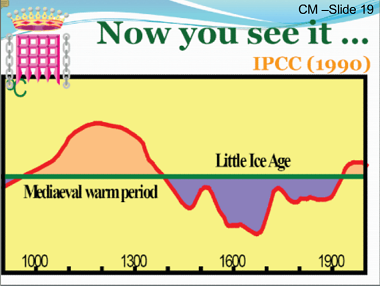
  • Was there a medieval warming period comparable to that taking place today, and did the IPCC “erase” that medieval warming period from its historical climate data?
  • Do IPCC’s climate sensitivity estimates really rest on just 4 scientific papers, rather than 2,500?
  • Have average temperatures actually been going down, contradicting IPCC projections?
  • Is there really no evidence for any catastrophic effects of anthropogenic climate change anywhere in the world?
  • Is it really true that increase in CO2 levels is an effect of warming rather than a cause, and is it really true that CO2’s effect on global temperature is negligible?
  • Is the extent of arctic sea ice actually remaining steady rather than declining?
  • Has the Greenland ice sheet really been increasing rather than decreasing?
  • Is it really true that the Himalayan glaciers have not been retreating?
  • Is it really true that oceans are not heating up?
  • Is it really true that global warming is caused by increased solar activity, rather than human activities?

If these kinds of questions concern you, I encourage you to review Abraham’s presentation.

AB — 29 June 2010

Gulf Disaster: Sparking an Explosion of Innovation in Oil Cleanup?

Sickening as it is, the unfolding oil disaster due to the runaway gusher in the Gulf of Mexico (the terms “leak” and “spill” hardly seem adequate) is giving rise to a flurry of innovations in oil cleanup that should result in more effective responses to such crises in the future.

Watching BP and the federal government flounder around these first several weeks of the disaster, many individuals, small businesses, and local officials in the Gulf region have stepped forward with cleanup solutions, some sophisticated and well-thought-out, some not so much (see “Battling oil with ‘Cajun ingenuity.’” But the point I’m making is that it’s interesting to see how a crisis like this is useful as a stimulus for innovation.

I’ve been able to dig up a few CNN reports that show examples.

Dragonfly floating triage center for cleaning oiled birdsI was particularly struck by a report just today about two boatmakers who have quickly generated a kind of floating “M*A*S*H” facility for cleaning up oiled birds. The unit is based on the design of shallow-draft fishing boats that can easily maneuver in coastal waters and marshlands. Birds can be picked up, cleaned, and released right from the boat, without the time-consuming process of taking them into land-based facilities. (See “Boatmakers: Oil officials ignoring bird-saving boats“)

As is often experienced by innovators within large companies and organizations, the two Alabama boatmakers, Mark Castlow and Jimbo Meador, have run into problems getting uptake of their innovation by the large bureaucratic entities running cleanup efforts.

CNN made calls to find out why the solution has not been exploited by BP and the government. The CNN journalist says that, “The unified command center admitted that juggling all the offers of help has been a problem.”

One of the boatmakers says, “It’s one of the most frustrating things I’ve ever been involved in.” So far, they have been able to produce a prototype boat with funds from private donors, including musician Jimmy Buffet. From here on out, they plan to produce a new boat every seven days.

When I heard that actor Kevin Costner was getting involved in cleanup efforts, my first reaction was, “Oh, ha-ha, he should get together with Brad Pitt and George Clooney, ha-ha!” But thanks again to CNN, I have learned that, in reality, Costner and his colleagues at their company, Ocean Therapy Solutions, are actually selling BP a cleanup device that he and his brother, a scientist, developed during the early 1990s.

Costner’s machine is a device for separating oil from water. His largest machine has about a 5′ x 5′ footprint, weighs about 4,000 pounds, and can separate 200 gallons of liquid a minute, separating oil and water at 99.9 percent purity on either side.

Costner brought the machine to market over a decade ago, but couldn’t raise any interest until the current crisis. “I guess people just thought spills were over,” he tells Anderson Cooper of CNN. But to the contrary, he says, “Spills occur on a daily basis. Someone said enough oil spills on a daily basis that every seven months we’re having an Exxon Valdez out there. It’s just, out-of-mind, out-of-sight. It takes something like this to happen, where now we’re all pointed at it.”

Costner took his product for years to government agencies and private industry with no success, but now BP has ordered 32 of the devices. Costner tells CNN, “I’ve had to be kind of silent the past few weeks as this machine was put through a lot of hoops, and it just passed everything that BP could throw at it.” (See Cooper’s video interview with Costner, “Kevin Costner’s solution to oil spill.” See also Ocean Therapy’s news release, “BP to Proceed With Costner Centrifuge Devices to Cleanup Gulf Oil Spill.”)

AB — 23 June 2010

Developing the Internet of Things and a Smarter Planet

A conversation earlier today with some of the innovation folks at IBM about their Smarter Planet initiative has got me revisiting some research we’ve done at the ILO Institute on a concept know as the “Internet of Things.” The essential idea is that objects in the physical environment around us are increasingly being embedded with networked technology, interacting with the larger network, and creating data. In fact, a video by IBM (shown below) suggests that there already might be more objects connected to the Internet than people.

I first encountered the Internet of Things concept in 2006 working on a report on the future of RFID (radio-frequency identification). RFID is a technology used to embed miniature wireless communications in objects of all kinds, such as packaging, boxes, equipment — even humans and animals. At that time I was in touch with some people working on the Internet of Things concept at MIT.

Charles Murray of MIT’s Auto-ID Center had written in Design News that “RFID will be the backbone” of this Internet of Things, “in which almost everything, large and small, is connected via the Web.”

In our 2006 report we wrote:

On a product level, says Murray, each item would be tagged by “a sort of Web page for each item” coded in HTML. “Thus, all products could be identified anywhere, instantly.” Plans include migrating from sticky tags to RFID devices embedded in cardboard cartons during the manufacturing process.

Murray speaks of this emerging Internet of Things in terms of the supply chain. However, the eventual possibilities go far beyond keeping track of products for supply chain management. If miniature Web pages and servers could be embedded in building materials, components of vehicles and aircraft, furniture, appliances, apparel, and other places, this could have huge implications for marketing, communication, and provision of services, not to mention changing the very nature of the world around us.

Wanting some further insights, I had a phone conversation with MIT’s Sanjay Sarma, an RFID expert at MIT. Sarma stressed the impact the Internet of Things will have on business:

MIT’s Sanjay Sarma tells ILO researchers that this Internet of Things is “going to have a huge impact,” and that RFID is one of the key enabling technologies. He points out that RFID creates a greatly increased connection between the physical world and the world of information by connecting more data to physical things and transferring it at much greater speeds in much greater volumes. “We used to connect data to the physical world through keyboards, but there’s only so much data you can get in through the keyboard. But with RFID it’s automatic and it’s happening all the time.”

Sarma says that the Internet of Things will allow you to “have control in your enterprise in a way that is completely unprecedented.” Sarma calls this control “high-resolution management—management with eyes everywhere, as opposed to management by gut reactions and guesswork.”

Earlier this year, we completed a report on how the Smart Grid is likely to affect the shape of the electric utility business in the future. If the smart grid initiative rolls out as anticipated (and utilities are working on this very aggressively right now), the electric grid in the U.S. will be transformed from the traditional century-old dumb one-way transmission utility into what Thomas Friedman has called an “Energy Internet” (see his book Hot, Flat, and Crowded, chapter 12, “The Energy Internet: When IT Meets ET”).

Under the Energy Internet paradigm, networked technologies will be embedded all through the electricity delivery system — in control facilities and substations, in smart meters at homes and businesses, in home appliances that will shut on and off in response to grid conditions, in electric vehicles and their charging systems, in home-based generating systems that will sell electricity back to the grid, and much more that we probably can’t imagine.

Friedman maintains that the smart grid will enable “a great energy transformation.” On page 286 of his book, he outlines what this could mean for utilities companies:

Utilities, instead of limiting their vision from the power plant to your home electricity meter, would be wholly transformed. Their universe would stretch from the generation of clean power on one end right into your home appliances, your car battery, and even the solar panels on your roof. Rather than just being a seller of dumb and dirty electrons, it would be an enabler of this whole smart grid-Energy Internet system. And it would make money from optimizing this system.

In effect, Friedman maintains, smart grid will bring utilities, businesses, and consumers together into an interactive energy market. Taking the reader forward in time, he projects how such a market might function (pages 277-278):

[N]ow that we’ve moved to the Energy Internet – the smart grid – utilities can run your refrigerator or adjust your thermostat in line with when the wind is blowing or the sun is shining. It can match the supply with the demand. Therefore, it can use more of these renewable power sources at much lower cost. When clouds block out the sun or the wind dies down, the utility’s smart grid lowers demand by raising prices (so your SBB [Smart Black Box] decides not to do the laundry then) or by adjusting your home temperature settings. And when the sun is shining brightly and the wind is howling, the utility runs your dryer at the lowest price. So there is now a direct correlation between how smart your grid is, how much energy efficiency it can generate, and how much renewable power it can use.

…. When the smart grid extended into a smart home all the way to a smart car, it created a whole new energy market on the other side of your electric meter. In the old days, there was no market beyond the raw dumb electrons that came into your house. Everything stopped at the meter, and you just paid the price calculated at the end of the month. But once your appliances became smart, and a Smart Black Box was introduced into your house, a market was also created beyond your meter and throughout your home, and, more broadly, inside every factory and business around the country.

How will the Internet of Things, a Smarter Planet, transform the world? My guess would be that what eventually emerges will surprise us all. As humans, our predictions tend to be vastly oversimplified. In our smart-grid report, we wrote,

It is good to remember that 20 years ago, experts were referring to the Internet as an “information superhighway” – not wrong in itself, but a vast oversimplification. How many pundits at that time could have foreseen today’s massive World Wide Web and e-commerce activity – not to mention Google or Facebook?

The implication, then, is that utility companies need to become generators not just of power but of innovation – watching for potential new ventures and business models that will surely arise out of such areas as smart-metering, electric vehicles, and renewables. Utilities need to start now building the organizational capabilities necessary to exploit the opportunities that will emerge in this networked energy marketplace – which means expanding R&D and internal venture funding, establishing entrepreneurial units and innovation teams, and building a new culture of innovation.

For some insights into the Internet of Things concept, I invite you to watch this thought-provoking video from IBM:

AB — 20 May 2010

Climate Change: A great side-by-side comparison of both sides’ views

One of the great challenges for an observer of public discourse these days is getting a clear, unbiased statement of both sides of an argument. People have powerful motivations to articulate only their opinion and trash the other side — see my previous entry, “Spin and Rhetorical Intimidation.”

So it was refreshing to come across the infographic linked below from Information Is Beautiful. The graphic provides a reasonable, neutral juxtaposition of both sides in the climate debate. (Click the image to see it full-size.)

AB — 8 December 2009

Social Critics on Social Darwinism: How Rushkoff and Wiker Converge

I recently completed two books by two very different authors, Douglas Rushkoff and Benjamin Wiker. However, the serendipitous fact that I read them one right after the other brought home to me some intriguing commonalities between the two, focusing particularly on the widespread societal effects of social darwinism.

The two books are:

Although I suspect that these two authors would be very far apart on political issues, my reading of these two books in juxtaposition emphasized two interesting commonalities:

  • Both authors comment on the origins and dangers of social darwinism.
  • The two authors both focus their historical analyses on roughly the same time period, from the Middle Ages to the present day.

In writing the above, I also came to an interesting realization on another more-subtle commonality: Wiker starts with the classic cynical treatise The Prince, by Niccolo Machiavelli. Rushkoff starts with the Middle-Age “princes” who created the corporation and imposed central currency in Europe.

Rushkoff’s premise is that the aristocracy in the Middle Ages devised the chartered corporation as a legal mechanism to give them control over commerce and wealth. Because of their privileged status granted by government, corporations have progressively gained more power, even becoming legal “persons” over time.

Rushkoff’s criticism is that Western society has become steeped in corporatism, and that this pits individuals against one another in a win-lose competitive struggle. People operate according to unconscious corporatist values and assumptions about how life should be and are prevented from connecting in a natural way through communities.

Wiker’s premise is that modern civilization has been affected by a materialistic, atheistic philosophical tradition preserved and promoted by a series of highly-influential thinkers and their books, starting with Machiavelli, then Thomas Hobbes, Rene Descartes, John Stuart Mill, Karl Marx, Charles Darwin, Sigmund Freud, Margaret Sanger, Margaret Mead, and Alfred Kinsey, along with others along the way.

As I said, where I see an important commonality between Rushkoff and Wiker is when it comes to their implications and comments about social darwinism: The modern world is strongly influenced by the idea that the natural order demands that the strong survive and the weak die off.

Ruskoff writes,

Richard Dawkins’s theory of the “selfish gene” popularized the extension of evolution to socioeconomics. Just as species competed in a battle for the survival of the fittest, people and their “memes” competed for dominance in the marketplace of ideas.

Human nature was simply part of biological nature, complex in its manifestations but simple in the core commands driving it. Like the genes driving them, people could be expected to act as selfishly as Adam Smith’s hypothetical primitive man, “the bartering savage,” always maximizing the value of every transaction as if by raw instinct.

Ironically, says Rushkoff, religionists were used to promote a compatible economic regime:

Right-wing conservatives turned to fundamentalist Christians to promote the free-market ethos, in return promising lip-service to hot-button Christian issues such as abortion and gay marriage.

It was now the godless Soviets who sought to thwart the Maker’s plan to bestow the universal rights of happiness and property on mankind. America’s founders, on the other hand, had been divinely inspired to create a nation in God’s service, through which people could pursue thier individual salvation and savings.

Rushkoff contends that

What both PR efforts had in common were two falsely reasoned premises: that human beings are private, self-interested actors behaving in ways that consistently promote personal wealth, and that the laissez-faire free market is a natural and self-sustaining system through which scarce resources can be equitably distributed.

Wiker follows the development of atheistic social darwinism from Machiavelli, but he takes considerable time to establish the connection between Darwin and eugenics. On pages 88 to 89 of 10 Books he quotes from Darwin’s Descent of Man (not as well known as On the Origin of Species):

With savages, the weak in body or mind are soon eliminated; and those that survive commonly exhibit a vigorous state of health …. We civilized men, on the other hand, do our utmost to check the process of elimination [by means of various works of charity and relief]. Thus the weak members of civilised societies propagate their kind ….

If … various checks … do not prevent the reckless, the vicious and otherwise inferior members of society from increasing at a quicker rate than the better class of men, the nation will retrograde, as has occurred too often in the history of the world.

Wiker argues that the writings of Darwin and other atheistic thinkers have led to a modern world in which the weak are seen as expendable for the good of human progress.

At the end of his book, Wiker comments:

We are so fond of thinking of our progress from the simple savage that we forget to take account of whether we are really progressing in some sort of virtue or rather becoming more complexly and deviously savage.

We have a higher regard for health than our ancestors did, and a far greater knowledge of biology. But when biology, rather than theology, becomes the queen of the sciences, then Christian prohibitions against eugenics, the elimination of the unfit or the unwanted through abortion or infanticide, or the elimination of diseased races or classes all become merely “medieval” and irrelevant.

Rushkoff and Wiker approach their analyses with very different objectives and foci, and it would be far from accurate to say that they reach the same conclusions.

But both Life Inc. and 10 Books That Screwed Up the World shine light on some of the historical and philosophical sources of the great streak of heartlessness evident in the modern world.

In about 1970, I was picked up hitchhiking on I-85 in North Carolina by an older fellow driving a sedan. We got into a conversation about the problems of the world. From his point of view, one of the biggest problems was welfare and charity — all the giveaway programs that are supposed to help the poor.

I raised the question, Well, what are they supposed to do? Suppose they need help to survive and get back on their feet?

His response was, “Who cares? Let ’em die. That’s the way nature works.”

I wonder who he had been reading.

AB — 4 September 2009

‘The Fog of War’: Nuances of Robert S. McNamara

Robert S. McNamara, who was Secretary of Defense under U.S. Presidents Kennedy and Johnson, died yesterday at age 93 — see today’s article in The Washington Post.

As a teenager during the Vietnam war, my view of McNamara was two-dimensional, you might say. For the black-and-white morality of a young war resister, he was the enemy.

Years passed, and I didn’t think about Robert McNamara much until 2004, when the documentary The Fog of War – Eleven Lessons from the Life of Robert S. McNamara came out.

Watching the movie, I was fascinated at the nuanced picture it presented of this once-controversial and divisive figure. The film includes comments from a long interview with McNamara. It would be over-simplifying to say that he admits he and other policy-makers were wrong in the way they prosecuted the Vietnam conflict. He really gives the viewer a sense of how hard it is for decision-makers to be certain they are doing the right thing.

Watching and listening to McNamara in his late-80s, I also remember feeling some shame at my previous attitude toward this somewhat stooped old fellow in his tan raincoat.

Can’t remember where I read it, but it was good advice: If you find yourself hating someone, try imagining them as a helpless little baby or as a very old person near the end of their life.

AB — 6 July 2009

Iranian sources: Fatwa by Ayatollah Yazdi authorized rigging of election; Whistleblower Asgari was assassinated

[Updated 24 Sept. 2009]

An open letter purporting to be from a group of employees at Iran’s Interior Ministry says that a hard-line ayatollah authorized election supervisors to alter the election results so President Ahmadinejad would win re-election. According to contacts in the Iranian defense department, an IT (information technology) manager in the Interior Ministry was murdered after he leaked information about the fraud to opposition candidates.

The implications given in the paragraph above are difficult to confirm in depth, given the news blackout in Iran. However, I do have sources with connections in Iran that lend reasonable credibility to this account.

In terms of the fatwa authorizing election supervisors to rig the results, Tehran Bureau, a news organization reporting on Iranian affairs, has published an open letter purporting to be written by a group of employees in the Iranian Interior Ministry (the agency in charge of the country’s elections) — here is a link to a copy of the letter in Persian.

I don’t read Persian, but Tehran Bureau has furnished a partial translation — see “Open Letter: Fatwa Issued for Changing the Vote in Favor of Ahmadinejad.”

According to the translation, the fatwa came from a well-known cleric who previously preached about political philosophy at Friday prayers in Tehran, identified by Tehran Bureau as Ayatollah Mohammad Taghi Mesbah Yazdi.

The letter says that in May of this year the government realized that Ahmadinejad’s political support was waning in favor of opposers. This led Yazdi to meet in secret with election supervisors. Citing the Quran, Yazdi told the supervisors,

If someone is elected the president and hurts the Islamic values that have been spread [by Mr. Ahmadinejad] to Lebanon, Palestine, Venezuela, and other places, it is against Islam to vote for that person. We should not vote for that person, and also warn people about that person. It is your religious duty as the supervisors of the elections to do so.

After criticizing the other candidates, Yazdi said,

You should throw away those who are unqualified, both morally and lawfully. Your highest call of duty at this time is to preserve your achievement.

The open letter describes the election supervisors as “happy and energetic for having obtained the religious fatwa to use any trick for changing the votes,” and says they “began immediately to develop plans for it.”

Tehran bureau describes itself as “a virtual bureau connecting journalists, Iran experts, and readers all over the world.” A news release in February 2009 from the Columbia University School of Journalism says the bureau was started by Kelly Golnoush Niknejad, a U.S.-based journalist born in Iran. The release said that journalist Jason Rezaian would be covering the Iranian presidential election from Tehran.

I have sent an email to Niknejad asking more information about how her organization obtained a copy of the open letter, but she has not replied as of today.

In researching this story, I read in the Guardian about “unconfirmed reports” that an Iranian whistleblower had been murdered for revealing the election fraud — see “Iran protests: Regime cracks down on opposition as further unrest looms,” by Ian Black, Robert Tait and Mark Tran. Black and colleagues reported that,

Mohammad Asgari, who was responsible for the security of the IT network in Iran’s interior ministry, was killed yesterday in a suspicious car accident in Tehran. Asgari had reportedly leaked evidence that the elections were rigged to alter the votes from the provinces. Asgari was said to have leaked information that showed Mousavi had won almost 19m votes, and should therefore be president.

I found that it was difficult to get further confirmation of this report, but it seemed valuable to do so, as it in turn would confirm the implications of the open letter from the Interior employees.

Finally I was able to get in touch with Rob (Sohrab) Shahmir, an Iranian in Toronto, who is now chairman of E&I Renewable Energies and CEO of E&I Group. Shahmir was working in Iran from 1998 to 2007 in environmental services and removal of landmines and unexploded ordinance.

Shahmir still has contacts in the Ministry of Defense in Iran. He tells me that, according to his contacts,

Mr. Asgari was a manager at the IT department of the Ministry of Interior, he was one of the few semi-senior supporters of the moderates at the ministry.  After they ministry was ordered to flip the results and declare Ahmadinejad the winner by the office of the leadership, Mr. Asgari released the information to the offices of Mr. Mousavi and Karoubi.
According to my contacts, after the Revolutionary Guards Counter Intelligence Group discovered his identity, Sardars (Generals) Naghdi, and Safavi ordered his assassination.  Consequently, his vehicle was run over by a Truck (one the size of a coal truck).  The pic is of the acutal truck.

Mr. Asgari was a manager at the IT department of the Ministry of Interior. He was one of the few semi-senior supporters of the moderates at the ministry.  After the ministry was ordered to flip the results and declare Ahmadinejad the winner by the office of the leadership, Mr. Asgari released the information to the offices of [opposition leaders] Mr. Mousavi and Karoubi.

truck that killed AsgariAccording to my contacts, after the Revolutionary Guards Counter Intelligence Group discovered his identity, Sardars (Generals) Naghdi and Safavi ordered his assassination. Consequently, his vehicle was run over by a truck (one the size of a coal truck).

Shahmir tells me that the photo shown here is the truck that was used to kill Asgari.

Update 11 Sept. 2009: Jeremy Hammond at Foreign Policy Journal has written an extensive analysis of the coverage of the reputed Yazdi fatwa. See “The Case of the ‘Fatwa’ to Rig Iran’s Election.”

Update 24 Sept. 2009: Muhammad Sahimi of Tehran Bureau has responded to critics of the account of the Yazdi fatwa — see “America’s Misguided Left.”

AB — 22 June 2009