Why People Don’t Believe Scientists Even When There Is ‘Consensus’

An interesting study, soon to appear in the Journal of Risk Research, by Yale law professor Dan M. Kahan and colleagues, suggests that people tend to disbelieve scientists whose cultural values are different than theirs.

I’m not able to determine when this study will be published, but you can find an abstract at this link, and I was able to download a preliminary version of the whole article in PDF by clicking on the link on that page that says “One-Click Download.”

These conclusions shed light on the debate over anthropogenic climate change, Kahan tells Science Daily (“Why ‘Scientific Consensus’ Fails to Persuade“):

We know from previous research that people with individualistic values, who have a strong attachment to commerce and industry, tend to be skeptical of claimed environmental risks, while people with egalitarian values, who resent economic inequality, tend to believe that commerce and industry harms the environment.

(For more on the climate-change controversy, see my previous entry, “John Abraham’s Point-by-Point Rebuttal of Climate-Skeptic Monckton.”

Kahan and colleagues based their study on the theory of the cultural cognition of risk. In his paper, Kahan says this theory “posits a collection of psychological mechanisms that dispose individuals selectively to credit or dismiss evidence of risk in patterns that fit values they share with others.”

The researchers surveyed a representative sample of 1,500 U.S. adults. They divided this sample into groups with opposite cultural worldviews, some favoring hierarchy and individualism, the others favoring egalitarianism and communitarianism.

They surveyed the respondents to determine their beliefs about what in fact is the scientific consensus on issues of climate change, disposal of nuclear waste, and concealed handguns, with particular focus on the associated levels of risk in each of those areas. Various statements were attributed to fictional personas portrayed as authors of books on these various issues. Respondents were asked to judge whether each author is really an expert or not.

Analysis of the results on the climate-change issue revealed that:

Disagreement was sharp among individuals identified (through median splits along both dimensions of cultural worldview) as “hierarchical individualists,” on the one hand, and “egalitarian communitarians,” on the other. Solid majorities of egalitarian communitarians perceived that most expert scientists agree that global warming is occurring (78%) and that it has an anthropogenic source (68%). In contrast, 56% of hierarchical individualists believe that scientists are divided, and another 25% (as opposed to 2% for egalitarian communitarians) that most expert scientists disagree that global temperatures are increas-ing. Likewise, a majority of hierarchical individualists, 55%, believed that most expert scientists are divided on whether humans are causing global warming, with another 32% perceiving that most expert scientists disagree with this conclusion.

The study revealed similar results around the issues of geologic isolation of nuclear wastes and concealed-carry laws.

So should we conclude that people are going to believe what they want to believe, and that’s all there is to it? The authors make an interesting statement about the implications for public presentation of scientific findings:

It is not enough to assure that scientifically sound information — including evidence of what scientists themselves believe — is widely disseminated: cultural cognition strongly motivates individuals — of all worldviews — to recognize such information as sound in a selective pattern that reinforces their cultural predispositions. To overcome this effect, communicators must attend to the cultural meaning as well as the scientific content of information.

The report suggests some ways that cultural meaning might be considered in communicating with the public. One such strategy is what the authors call narrative framing:

Individuals tend to assimilate information by fitting it to pre-existing narrative templates or schemes that invest the information with meaning. The elements of these narrative templates — the identity of the stock heroes and villains, the nature of their dramatic struggles, and the moral stakes of their engagement with one another — vary in identifiable and recurring ways across cultural groups. By crafting messages to evoke narrative templates that are culturally congenial to target audiences, risk communicators can help to assure that the content of the information they are imparting receives considered attention across diverse cultural groups.

AB — 24 Sept. 2010

‘Snowflake Method’ Offers Innovative Method for Writing a Novel (via A. Roy King)

A. Roy King wrote up a good summary of Randy Ingermanson’s “Snowflake Method” for fiction writing:

'Snowflake Method' Offers Innovative Method for Writing a Novel On his Advanced Fiction Writing web site, physicist and fiction author Randy Ingermanson offers an exciting method for developing a novel, called the 'Snowflake Method,' which he describes in detail on his page, "How to Write a Novel: The Snowflake Method." Since encountering the Snowflake Method, I've been using it on my current fiction project, and I find that it's interesting and fun and is helping me to focus in on the story in a marvelous wa … Read More

via A. Roy King

‘Quriosity’ Is Dead – Long Live ‘A Thinking Person’

Readers of Quriosity.com will be interested to learn that I have sold that domain (someone made me an offer I couldn’t refuse). As a result, I have transferred all Quriosity content to the new domain and blog AThinkingPerson.com.

You’ll be glad to know that A Thinking Person will continue to publish the same brilliant commentary you have come to expect from Quriosity.

The new RSS feed address for A Thinking Person is https://athinkingperson.com/feed/ .

AB — 14 September 2010

Wake County, NC, Survey About Littering

The Raleigh News & Observer carried a story today about a new survey by the Wake County Environmental Services department about roadside littering in the county. (See “Wake is surveying our littering habits.”)

I confess that littering is a big pet peeve for me. It’s hard for me to conceive how anybody could think it doesn’t matter if they throw trash on the ground.

A news release from the county says the survey will study “the attitudes and perception of littering among Wake County citizens.” Survey questions focus on “awareness of litter; perceived location of, and problems associated with litter; personal experience with littering; perceptions of causes of littering and willingness to participate in voluntary litter-cleaning programs.” The results will be used in the development of an anti-litter awareness campaign. (See “Wake Conducts Roadside Litter Survey.”)

If you live in Wake County and you’re interested in taking the littering survey, follow this link.

AB — 1 September 2010

John the Baptist’s Bones and BBC’s Quotation Marks

A BBC article today (3 August 2010) highlights the discovery of a small box of bones reputed to be the remains of John the Baptizer, who announced Jesus’ appearance as Messiah and baptized him, and who was later executed by Herod Antipas — see “Remains of St John the Baptist ‘found’.”

I’m always intrigued by archaeological discoveries that relate to Biblical accounts. The article includes a video showing the find, and it’s interesting to watch (aside from some silly clerical comments about the find’s significance).

But more than anything, what this article brought to mind was the frequent and peculiar use of quotation marks (or single quotation marks, more accurately) by BBC’s headline writers. Look at the headline again:

Remains of St John the Baptist ‘found’

Now in standard written American English, a writer would most often use quotation marks in this way to express irony or skepticism. (For example, “My neighbor plays that ‘music’ too loud,” perhaps referring to rap or heavy metal.)

But in the case of the story about John’s bones, what is the headline writer skeptical about? Maybe the writer is doubtful that these bones were really ‘found’? Perhaps the writer suspects that some Orthodox priest fabricated them?

I’ve noticed other puzzling uses of quotation marks in BBC headlines. Here are some examples:

  • BP ready to plug ‘biggest leak’
  • ‘Ground Zero mosque’ moves closer
  • State ‘can challenge health law’
  • Paraguay star Cabanas ‘recalls little’ of shooting
  • Schumacher ‘almost disqualified’

My best guess would be that this practice has something to do with attribution —  the headline writer is limited by a certain number of characters, but doesn’t want to stick his neck out by actually calling the Cordoba House cultural center “the Ground Zero mosque.” So he has decided to put quotation marks around the phrase to indicate that other people are calling it the Ground Zero mosque but that he doesn’t feel comfortable calling it that.

I’ll bet this practice has been thrashed out after many days of argument at the BBC offices.

After a little investigation I have found that quotation marks used to express irony or skepticism are called “scare quotes.” The gestural version is called “air quotes.” Somehow in all my years as a writer and English student, I have never come across these terms. See the Wikipedia article about “Scare quotes.”

The Wikipedia editors write that, besides denoting irony or skepticism, scare quotes can “serve to distance the writer from the quoted content” and to “convey a neutral attitude on the part of the writer, while distancing the writer from the terminology in question.”

This could be the BBC’s reasoning for the odd way it uses single quotation marks in its headlines. (These might be called “inverted commas” in the hallowed halls of the BBC.)

I also found a useful discussion of the BBC headline conundrum at Wordwizard, a surprisingly active discussion forum dedicated to English words and usage — see “The BBC’s use of quotation marks.” In the discussion, which took place in December 2009, Erik Kowal shares these insights:

This habit of the BBC’s web writers is difficult to understand. I presume that sometimes they are quoting someone without direct attribution, but this does not explain why they do it when the facts described within quotation marks are unquestionable and do not need to be signalled as being opinions or unchecked assertions (which the BBC should not be basing its news stories on in any case).

The practice makes it appear as though the BBC has no confidence in its own reporting, or that it is suggesting that its sources are not to be trusted. Regardless, it is highly irritating and even patronizing.

It also reminds me of the equally annoying habit that some people have of giving capitals For No Real Reason to Certain Words they feel are Particularly Important.

AB — 3 August 2010

John Abraham’s Point-by-Point Rebuttal of Climate-Skeptic Monckton

[Updated 16 July 2010]

Yesterday I reviewed an informative presentation by John P. Abraham, associate professor in the school of engineering of St. Thomas University in Minnesota. In his presentation, “A Scientist Replies to Christopher Monckton,” Abraham offers a point-by-point rebuttal/refutation of claims made in a presentation he attended by Christopher Monckton, in which Monckton presented arguments against anthropogenic (man-made) global warming (AGW), that is, the idea that human activity is causing an increase in global temperatures resulting in dangerous climate change.

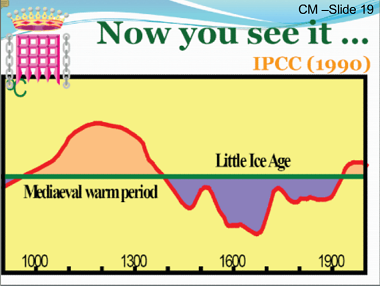
Monckton is Chief Policy Adviser at the Science and Public Policy Institute (SPPI) and is well-known as a critic of anthropogenic global warming. (See one of Monckton’s slides referenced by Abraham, to right.)

Though long (it’s a 73-minute Flash presentation with voiceover), Abraham’s critique of Monckton is well worth reviewing, especially if you’ve been wondering about the emerging criticism of AGW and the general scientific consensus on climate change.

[Update added 16 July 2010]: A reader (see his comment below) has kindly pointed me to Monckton’s response to Abraham’s presentation. This is in PDF format and is very long — his answer is in the form of a series of questions (500 of them). See “Response to John Abraham, by Christopher Monckton.”

I have to say that, although I tend to agree with the consensus position in this case, just because most or even all of the experts in a certain field believe the same way, I don’t think others should be obligated to follow the crowd. And those who do accept the consensus point of view should be willing to keep their convictions on the table and to re-examine matters when new information becomes available.

To say that those who question claims of climate-change are “anti-science” or to call them “deniers” (as if their challenges were somehow akin to denials of the Holocaust) is disingenuous and counter-productive. It gets people arguing about all the wrong things, instead of communicating and working on problems.

In the case of the challenges to the climate-change consensus, science itself is not being called into question. The real issues have to do with things like politics, public policy, economic philosophy, and ideology. If people’s livelihoods and the well-being of their descendants are in play, isn’t it reasonable to allow them to call into question the conclusions and policy implications of those who evoke climate science as justification for their policy recommendations?

Also, it’s reasonable to point out that scientists themselves are humans with their own foibles, and while for the most part they might believe they are carrying out their work according to well-established principles and sound procedures, some of them have shown themselves to be influenced by self-interest, greed, and ideological leanings. So if their work is financed with public resources and being used to influence policy, isn’t it reasonable to expect their work – and especially their statements about its implications – to stand up to public scrutiny?

If researchers and institutions are convinced that anthropogenic global warming is a real danger, then it would behoove them to find ways to present the evidence in an accessible way, rather than just sticking their noses in the air and spouting arrogant put-downs of those that raise questions.

That brings me to the value of John P. Abraham’s presentation.

Sample slide from Abraham presentationI found Abraham’s presentation reasonable and level-headed (see one of his slides to right). He refrains from personal attacks. Abraham analyzes Monckton’s scientific references, charts, and assertions in detail. Where available, he examines the data sources for Monckton’s charts and the papers he references. He even wrote to the authors of many of the original papers to ask for clarification when needed and shows their replies in his presentation.

Abraham’s presentation is really produced as a point-by-point refutation of Monckton, but along the way you learn a lot about climate change and the associated data. Pretty easy to follow, for a non-specialist reader with a fair understanding of science.

“My goal,” he says, “is to show people how they can learn about the scientific understanding on their own.”

The questions he addresses include:

  • Has Al Gore really overestimated the future sea-level rise by 100 times, and is it really true that sea levels are not rising?
  • Are polar bears in the Canadian Beaufort Sea really endangered by warming temperatures or not?
  • Was there a medieval warming period comparable to that taking place today, and did the IPCC “erase” that medieval warming period from its historical climate data?
  • Do IPCC’s climate sensitivity estimates really rest on just 4 scientific papers, rather than 2,500?
  • Have average temperatures actually been going down, contradicting IPCC projections?
  • Is there really no evidence for any catastrophic effects of anthropogenic climate change anywhere in the world?
  • Is it really true that increase in CO2 levels is an effect of warming rather than a cause, and is it really true that CO2’s effect on global temperature is negligible?
  • Is the extent of arctic sea ice actually remaining steady rather than declining?
  • Has the Greenland ice sheet really been increasing rather than decreasing?
  • Is it really true that the Himalayan glaciers have not been retreating?
  • Is it really true that oceans are not heating up?
  • Is it really true that global warming is caused by increased solar activity, rather than human activities?

If these kinds of questions concern you, I encourage you to review Abraham’s presentation.

AB — 29 June 2010

Which evil and crazy movements have the potential to scale?

Which evil and crazy movements have the potential to scale?

There’s plenty of craziness in the world. But evil only has widespread effect if it finds a way to scale, as in Nazi Germany, Rwanda, and Al Qaeda.

So, my questions are,

What are the factors that allow evil movements to reach scale?

What are the crazy movements today that have the potential to scale and create havoc?

AB — 29 June 2010

Gulf Disaster: Sparking an Explosion of Innovation in Oil Cleanup?

Sickening as it is, the unfolding oil disaster due to the runaway gusher in the Gulf of Mexico (the terms “leak” and “spill” hardly seem adequate) is giving rise to a flurry of innovations in oil cleanup that should result in more effective responses to such crises in the future.

Watching BP and the federal government flounder around these first several weeks of the disaster, many individuals, small businesses, and local officials in the Gulf region have stepped forward with cleanup solutions, some sophisticated and well-thought-out, some not so much (see “Battling oil with ‘Cajun ingenuity.’” But the point I’m making is that it’s interesting to see how a crisis like this is useful as a stimulus for innovation.

I’ve been able to dig up a few CNN reports that show examples.

Dragonfly floating triage center for cleaning oiled birdsI was particularly struck by a report just today about two boatmakers who have quickly generated a kind of floating “M*A*S*H” facility for cleaning up oiled birds. The unit is based on the design of shallow-draft fishing boats that can easily maneuver in coastal waters and marshlands. Birds can be picked up, cleaned, and released right from the boat, without the time-consuming process of taking them into land-based facilities. (See “Boatmakers: Oil officials ignoring bird-saving boats“)

As is often experienced by innovators within large companies and organizations, the two Alabama boatmakers, Mark Castlow and Jimbo Meador, have run into problems getting uptake of their innovation by the large bureaucratic entities running cleanup efforts.

CNN made calls to find out why the solution has not been exploited by BP and the government. The CNN journalist says that, “The unified command center admitted that juggling all the offers of help has been a problem.”

One of the boatmakers says, “It’s one of the most frustrating things I’ve ever been involved in.” So far, they have been able to produce a prototype boat with funds from private donors, including musician Jimmy Buffet. From here on out, they plan to produce a new boat every seven days.

When I heard that actor Kevin Costner was getting involved in cleanup efforts, my first reaction was, “Oh, ha-ha, he should get together with Brad Pitt and George Clooney, ha-ha!” But thanks again to CNN, I have learned that, in reality, Costner and his colleagues at their company, Ocean Therapy Solutions, are actually selling BP a cleanup device that he and his brother, a scientist, developed during the early 1990s.

Costner’s machine is a device for separating oil from water. His largest machine has about a 5′ x 5′ footprint, weighs about 4,000 pounds, and can separate 200 gallons of liquid a minute, separating oil and water at 99.9 percent purity on either side.

Costner brought the machine to market over a decade ago, but couldn’t raise any interest until the current crisis. “I guess people just thought spills were over,” he tells Anderson Cooper of CNN. But to the contrary, he says, “Spills occur on a daily basis. Someone said enough oil spills on a daily basis that every seven months we’re having an Exxon Valdez out there. It’s just, out-of-mind, out-of-sight. It takes something like this to happen, where now we’re all pointed at it.”

Costner took his product for years to government agencies and private industry with no success, but now BP has ordered 32 of the devices. Costner tells CNN, “I’ve had to be kind of silent the past few weeks as this machine was put through a lot of hoops, and it just passed everything that BP could throw at it.” (See Cooper’s video interview with Costner, “Kevin Costner’s solution to oil spill.” See also Ocean Therapy’s news release, “BP to Proceed With Costner Centrifuge Devices to Cleanup Gulf Oil Spill.”)

AB — 23 June 2010

Hollerin’ — one thing we know how to do in North Carolina

The announcement of the winner of the National Hollerin’ Contest held over the past weekend in Spivey’s Corner, North Carolina, USA, reminded me of this time-honored southern tradition. I first became aware of it when a rock festival I attended about 40 years ago included a marvelous performance by the winner of the contest, who hollered a fantastic version of “Old Time Religion.”

This year, Tony Peacock of Siler City, NC, won the contest with a rendition of Gershwin’s “Summertime,” hollered in just under four minutes. See the announcement today in the News & Observer: “N.C. hollerer wins with ‘Summertime.'”

There are some things that can happen only in North Carolina, and this is one of them. (Other examples are Benson’s Mule Days, the town of Lizard Lick, and the correct understanding of what constitutes barbecue — but we can discuss those another day.)

It’s a crime that there is no video of Peacock’s performance on YouTube, but this video from a few years ago has some nice examples of hollerin’, ending with a version of “Amazing Grace”:

In this video, the hollerer does a little lecturing about the practice:

AB — 22 June 2010