Jeff Bredenberg of Oreland, Pa., has died, March 2, 2010

Jeff Bredenberg Nov. 2009My brother, Jeff Bredenberg, died at home in Oreland, Pa., on Tuesday night, March 2, 2010. He had been sick with brain cancer for about 2 1/2 years.

Jeff and I are both natives of Raleigh, NC. Some readers might know him as a Raleighite. Others might know him for his work in the newspaper world or book publishing. Recently he had become known for his How to Cheat … book series, which included How to Cheat at Cleaning — see How to Cheat Books.

A memorial service for Jeff will take place this Saturday, March 6, 2010, at 1 p.m., at the BuxMont Unitarian Universalist Fellowship in Warrington, Pa. — this link should lead to a map.

Here is the text of Jeff’s obituary — see also the versions in the Philadelphia Inquirer and in the Raleigh News & Observer for March 5:

Jeffrey Ellis Bredenberg

Nov. 26, 1953, to March 2, 2010
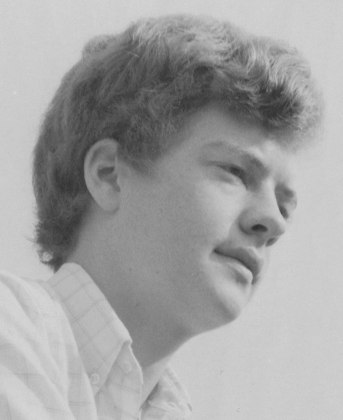
Jeff Bredenberg about 1970Jeffrey Ellis Bredenberg, 56, a former newspaper editor who later wrote and edited books, died Tuesday, March 2, 2010, of glioblastoma, a brain tumor, at his home in Oreland, Pa.

He completed two books after his diagnosis in September 2007.

A native of Raleigh, N.C., he got his first newspaper job at age 16 working as a copy boy and then copy editor for the News & Observer in Raleigh, N.C. He then worked for newspapers in Fort Myers, Fla., Burlington, Vt., Chicago, St. Louis, Denver, and Wilmington, Del. He worked for the News Journal in Wilmington as an assistant managing editor from 1988 to 1994. During that time, he redesigned the newspaper and supervised various newsroom departments.

In 1994, he joined the book division of Rodale Press in Emmaus, Pa., rising to the rank of managing editor. In 1998, he became vice president for content for the Internet health portal Intelihealth.com, based in Blue Bell, Pa. Since 2002, he had worked as a freelance writer and editor of books and articles (www.jeffbredenberg.com).

During his career, he wrote, edited, or otherwise contributed to more than 25 books. His most recent releases were a how-to series, How to Cheat at Cleaning, How to Cheat at Organizing, How to Cheat at Home Repair, and How to Cheat at Gardening and Yard Work (www.howtocheatbooks.com).

He appeared frequently in print articles, online, and on television. His TV appearances included “The Late Show with David Letterman,” “The Rachael Ray Show,” and “The Today Show—Weekend Edition.”

Jeff graduated from Needham Broughton High School in Raleigh in 1972. His higher education was a patchwork affair, including a year at North Carolina State University and classes at Edison Community College in Fort Myers, Fla., the University of Vermont in Burlington, and Temple University.

He met his wife, Stacey Burling, at the Rocky Mountain News, where he worked as an editor and she was a reporter. They married in 1988 in Denver.

Jeffrey Ellis Bredenberg 1955He frequently participated in events at his sons’ Cub and Boy Scout troops, volunteered with the youth group at BuxMont Unitarian Universalist Fellowship, and rarely missed his sons’ soccer or baseball games or band concerts.

He is survived by his wife; sons Adam and Colin; his mother, Gladys Bredenberg, of Raleigh; and his brother and sister-in-law, Alfred and Virginia Bredenberg, of Raleigh. His father, Paul Bredenberg, a retired philosophy professor at North Carolina State University, died in November 2009.

A memorial service will be held at 1 p.m., Saturday, March 6, 2010, at BuxMont Unitarian Universalist Fellowship, 2040 Street Rd., Warrington, Pa. 18976.

In lieu of flowers, contributions may be made to the National Brain Tumor Society, East Coast Office, 124 Watertown St., Suite 2D, Watertown, MA 02472.

AB — 4 March 2010

Favorite Places: Raleigh Little Theatre and Rose Garden

John Morris’s article today on Goodnight, Raleigh highlighted one of my favorite places here in the beautiful city of Raleigh, NC, where I was born and grew up — see “The Splendor of Raleigh’s Little Theatre and Rose Garden.” This cultural treasure is only a short walk from NCSU and the Cameron Village shopping center. (See the Little Theatre’s web site for information about the organization and its productions.)

Morris includes some great photos of the Rose Garden and amphitheater. Most interesting to me are historical photos, such as the one linked here to the right, from the theater’s construction during the 1930s.

Thinking about the Rose Garden conjures up a wealth of memories for me. When I was a teenager during the 1960s, my church, the Raleigh Unitarian Fellowship, met at the Little Theatre for a time on Sundays. About 1969, when I was in high school, a group of us held an anti-war rally in the amphitheatre. We were most amused when a guy showed up and tried to be surreptitious while taking photos of us with a telescopic camera lens — a representative of the city the police department, as I later learned during a conversation with a police captain.

One night about 1971, some friends and I walked down at night and approached the amphitheater from the back through the rose garden. The place was crowded and lit up, and, in our altered state of mind at the time, we were amazed when a cowboy walked by us in the garden, leading a horse. My friend Ray turned to me with a twinkle in his eye and said, “Must be gettin’ close to town.”

As it turned out, this was a dress rehearsal for an outdoor performance of Oklahoma — we sat down on the concrete bleachers and enjoyed the show for awhile.

My most memorable visit to the Rose Garden, though, was an outing several of us had there during a total eclipse, which I believe was in March 1970.

Here are some photos of the Rose Garden from a recent visit by me and Virginia and our friend Ellin from Vermont.

AB — 6 January 2010

Paul A. Bredenberg of Raleigh, NC, has died, Nov. 15, 2009

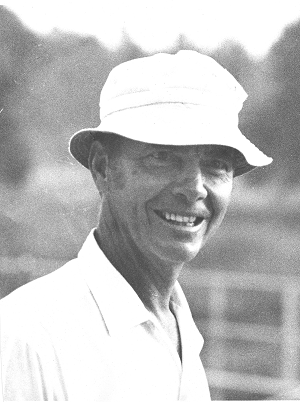
Following is the obituary I wrote for my father, Paul A. Bredenberg, at his death in 2009. Originally a version of this appeared in the Raleigh newspaper. However, it looks to me as if now you have to pay to keep such an obituary available online. (Too bad, because it was expensive to have it published in the first place, and web server space costs next to nothing.) I wanted to make sure there was a permanent version available, so here it is. [ARB, 18 August 2018]

Paul Arnold Bredenberg Ph.D.

PaulABredenbergAndTennisHatAbt1965_smallOct. 24, 1923 – Nov. 15, 2009

  • Professor Emeritus, North Carolina State University, Department of Philosophy and Religion, 1950-1986
  • Ensign, U.S. Navy, World War II
  • Civil Rights Activist
  • Athlete and Promoter of Youth Sports

Paul Arnold Bredenberg Ph.D. died on Sunday, Nov. 15, 2009, at Mayview Convalescent Center, in Raleigh, N.C., at the age of 86.

Paul Bredenberg had lived in Raleigh since 1950, where he raised a family, taught philosophy for 36 years at North Carolina State University (NCSU), spearheaded a youth tennis program that fostered an entire generation of Raleigh tennis players – and became known as a champion of civil rights in North Carolina and the Triangle region (Raleigh-Durham-Chapel Hill).

Paul Arnold Bredenberg was born Oct. 24, 1923, in Schenectady, N.Y., to Alfred Bredenberg Jr. and Cora Edith (Felton) Bredenberg. Paul’s grandfather, also named Alfred Bredenberg, had emigrated to the United States from Sweden, settling in upstate New York. In 1926, Paul’s family moved from Schenectady to Erie, Pa., where Paul grew up.

Paul is survived by his wife of 62 years, Gladys Marie (Ellis) Bredenberg; his brother Willard Alfred Bredenberg; his sons Alfred R. Bredenberg and wife Virginia of Raleigh and Jeffrey E. Bredenberg and wife Stacey Burling of Oreland, Pa.; and grandchildren Paul W. Bredenberg, Adam Bredenberg, Colin Bredenberg, Bevan Quinn, Jeremy Quinn, and Mauireen Quinn Bell.

Paul began attending the University of Pittsburgh in Erie in 1940, but his education was interrupted by World War II. During the war, Paul served as Ensign in the U.S. Navy on a destroyer in the South Pacific. At the war’s conclusion, he left the Navy, but not before meeting his wife-to-be, Gladys, in Charleston, S.C., where he was stationed and where she was living and working.

To continue his education, Paul returned to Pennsylvania, attending the University of Pennsylvania at Philadelphia. He graduated in 1947 with a bachelor’s degree in philosophy and returned to Charleston without delay (skipping his graduation ceremony) to get married to Gladys.

After their marriage, Paul and Gladys moved to New Haven, Conn., where Paul obtained a Ph.D. in philosophy at Yale University. During that period, 1947 to 1950, they lived for a time in New Haven with Paul’s aunt and uncle, Hilda and Fred Fowler, then in their own apartment.

After finishing graduate school, Paul and Gladys moved to Raleigh, where Paul had obtained a job as assistant professor of philosophy and social studies at North Carolina State College (now University, NCSU, aka “State”).

Paul and Gladys’s first son, Alfred Roy Bredenberg, was born in 1951 and their second son, Jeffrey Ellis Bredenberg, in 1953. When the boys were small, the family lived on Carlton Ave. in Raleigh, near the college campus. For the academic year of 1955 to 1956, the family moved temporarily to Palo Alto, Calif., where Paul studied poetry under Ivor Winters at Stanford University, on a Ford Foundation Faculty Fellowship. He also obtained a Rockefeller Foundation grant to study at Harvard University during the summer of 1956. Paul was promoted to Professor at State in 1963.

In 1962, Paul and Gladys and boys moved to their new home on Crump Rd. in Raleigh, adjacent to an extensive tract of North Carolina state farmland, which is now NCSU’s Centennial Campus.

During his academic career, Paul chaired the Committee on Academic Freedom of the American Association of University Professors and served as president of the North Carolina Philosophical Association. Paul retired from the university in 1986.

Paul was known in North Carolina and the Triangle region as an advocate of civil rights. He served on a steering committee in 1969 that led to the establishment of the Wake County chapter of the American Civil Liberties Union (ACLU). After the chapter’s establishment, he served several terms on the board, including a stint as president. In 1992, he received the chapter’s W.W. Finlator Award, presented annually to local champions of civil rights.

For most of his life, Paul was an avid tennis player, becoming Raleigh city champion twice and achieving state ranking for his doubles play. He became known in the Raleigh area for his work in youth tennis, coaching the Raleigh boys’ tennis team and running a free Saturday youth tennis clinic for many years, contributing to the formation of a whole generation of Raleigh tennis players.

In 2005, Paul was honored at the NC Tennis Hall of Fame in Greensboro with a memorial pathway stone inscribed “In Honor of Paul Bredenberg, for All That You Did for Junior Tennis.”

After his retirement in 1986, Paul pursued many hobbies and special interests, including tennis and golf, deep sea fishing, vegetable gardening, pastel painting, matting and framing, and stone polishing. He and Gladys spent many glorious days at their vacation house near Sparta in Paul’s beloved North Carolina mountains.

In 1998, Paul and Gladys left their Crump Road home and moved to Whitaker Glen, a lovely retirement community in Raleigh, where they have enjoyed the company of many long-time friends and acquaintances. Paul became known for his contributions of stories, articles, essays, and poems for the Whitaker Glen newsletter.

In March of this year, Paul entered Mayview Convalescent Center, passing several peaceful months until his death on Sunday. Paul’s family wishes to extend their greatest thanks to Dr. James Parsons Jr., medical director, and the staff of excellent caregivers at Mayview, who showed so much compassion for Paul during his final days.

An informal gathering for family, friends, and acquaintances of Paul will be held Thursday, Nov. 19, 5:00 to 7:00 p.m., in the Whitaker Glen Building B Atrium, 501 E. Whitaker Mill Rd., Raleigh, N.C. 27608. Friends and family will be invited to share experiences and remembrances.

In lieu of flowers, donations may be sent to ACLU Wake County Chapter, c/o NC ACLU, PO Box 28004, Raleigh, NC 27617; or Unitarian Universalist Fellowship, 3313 Wade Ave., Raleigh, NC 27607.

—–

AB — 16 Nov. 2009

The Myth of Merit

I just finished reading Malcolm Gladwell’s book Outliers, an interesting study that contradicts much traditional thinking about success, merit, and entitlement.

The comforting aspect of Outliers is that it turns out that all those arrogant muckymucks who thought they were better than you really weren’t so special. But the downside is that neither are you.

The traditional narrative is that people who excel make it to the top through willpower, dogged effort, and especially through that magical spark of something that is only found in the hearts of special people. Gladwell marshals some quite persuasive evidence that the very successful people in the world — the outliers — really benefit from being born at the right time and from receiving the right kind of assistance and influences in their lives.

Bill Gates became successful because he had unlimited access to a timesharing computer as a teenager. The Beatles became successful because they got a gig in Hamburg, Germany, playing eight hours a day in a strip club (read the book to find out how this makes sense).

According to Gladwell, the important takeaway is that many more people could be much better at what they do if society could provide them with the kind of environment that allows success to happen.

Gladwell’s arguments and evidence are intriguing and persuasive. I have doubts about how much influence this book will have — the myth of merit is too seductive. People love rags-to-riches stories. Many successful people are convinced that they have made it because they tried really hard or were smarter than everybody else — or because they are specially blessed by God or some other higher power.

As I’ve said before, it’s easy to think God is on your side when all the lights are green.

AB — 24 Sept. 2009

Great comic strips about schizophrenia and bipolar disorder

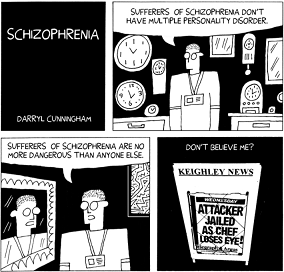
A student mental health nurse who is also a cartoonist is creating a book about mental illness. Calling himself “Tall Guy,” he has published his chapters on schizophrenia and bipolar disorder on his LiveJournal blog.

These comic strips are very informative as well as entertaining, and I think they are very accurate — I have studied counseling and abnormal psychology and worked for several years as a counselor and mental health worker in a psychiatric institution. I have also worked as a volunteer helper for mentally ill people and have friends and family members who suffer from mental illnesses.

Having befriended many people suffering from these disorders, I like to see others educate themselves about them. Tall Guy’s cartoons are a very accessible way to do that.

Here are links to his blog entries on schizophrenia and bipolar disorder:

Schizophrenia cartoon Bipolar cartoon

One source says Tall Guy’s name is Daryl Cunningham and that his book will be called Psychiatric Tales, to be published in 2010.

As an aside, for an alternative viewpoint on psychiatric medications, Crazy Meds is an interesting web resource. It’s a user-oriented web site “by crazy people for crazy people,” maintained by Jerod Poore, who calls himself “Chief Citizen Medical Expert.”

AB — 24 Sept. 2009

Why I can’t play piano

I just decided today that I can’t play piano because of my first-grade teacher’s southern accent.

For my first few days in the first-grade classroom of Miss Margaret Mackintosh at Mount Vernon Goodwin Elementary School in Raleigh, NC, in 1957, I was puzzled by the kids who left the classroom at odd times during the day to take Miss Margaret “out.”

I couldn’t understand why Miss Margaret would need little kids to take her out, presumably to dinner. I was even more puzzled because Miss Margaret did not go with them on these mysterious excursions. How could they take Miss Margaret out when she didn’t even go with them?

Later I learned I had been the victim of a linguistic difference between Miss Margaret and the dialect I learned at home. Miss Margaret was not in fact asking to be taken to dinner. She was inviting students to take piano, which she pronounced as “pee-ann-uh.”

Unfortunately, the piano-lessons boat had already left the dock, and I had missed my opportunity.

AB — 10 Sept., 2009

The couple in the iconic ‘Woodstock Photo’ – What’s wrong with this picture?

The other day I ran across a kind of cute story in the Daily News about the couple holding each other wrapped in a quilt, the photo of whom was used on the cover of the Woodstock album and has become one of those iconic 60s images — see “Woodstock concert’s undercover lovers, Nick and Bobbi Ercoline, 40 years after summer of love.”

Upon looking at the photo, though, what occurred to me was not how romantic or evocative the image might be, but how much litter is on the ground and what a mess the festival made. Here’s a link to the photo:

And here’s the same couple today (still married):

AB — 20 July 2009

New wristwatch uses a linear rather than circular clock face

Just yesterday I read on The Watchismo Times (a blog dedicated to unusual timepieces) about a new mechanical wristwatch designed with a linear time display rather than the traditional circular clock face. (See “Urwerk King Cobra CC1 Reintrepretation of 1958 Patek Philippe Cobra Prototype – Cylindrical Retrograde Linear Jumping Hour Display.”)

This design is thought-provoking: We normally conceive of time as a line, and yet for centuries the standard timepiece interface has been a circle. The author of the Watchismo site explains why this is:

Why do we think of time as travelling in a straight line yet display it rotating around a circle? The answer is straightforward: mechanisms that continually rotate are much simpler to produce than those that trace a straight line then return to zero. In fact, the latter is so difficult that, until now, nobody has ever managed to develop a production wristwatch with true retrograde linear displays.

It makes me think about how I conceive time personally. In the big picture, I think I do see time as a straight line going infinitely to the left and right.

In spite of the more linear design of the calendars I use, I believe I conceive of the calendar as a circle, as if the year were superimposed on a standard clock face. However, in my mind, the calendar runs counterclockwise with January at approximately the 11:00 position. I think my circular conception of the calendar comes from the periodic nature of the solar year. Why the year goes counterclockwise in my mind I don’t know.

When it comes to my conception of days, though, I see some ambiguities. I do conceive of them on some level as a circle of 24 hours, but on reflection I think that conception is at least partly based on the circular clock faces we use to keep time, as well as on the collective 24-hour standard we use to keep our society synchronized.

Certainly the new Urwerk King Cobra CC1 provides food for thought about how we think about time and about the user interfaces of the devices we use to keep track of it. Below is a link to Watchismo’s picture of the watch. Watchismo also provides many fascinating details about how the watch is designed and constructed.

Urwerk linear wristwatch

AB — 10 July 2009