‘Quriosity’ Is Dead – Long Live ‘A Thinking Person’

Readers of Quriosity.com will be interested to learn that I have sold that domain (someone made me an offer I couldn’t refuse). As a result, I have transferred all Quriosity content to the new domain and blog AThinkingPerson.com.

You’ll be glad to know that A Thinking Person will continue to publish the same brilliant commentary you have come to expect from Quriosity.

The new RSS feed address for A Thinking Person is https://athinkingperson.com/feed/ .

AB — 14 September 2010

John the Baptist’s Bones and BBC’s Quotation Marks

A BBC article today (3 August 2010) highlights the discovery of a small box of bones reputed to be the remains of John the Baptizer, who announced Jesus’ appearance as Messiah and baptized him, and who was later executed by Herod Antipas — see “Remains of St John the Baptist ‘found’.”

I’m always intrigued by archaeological discoveries that relate to Biblical accounts. The article includes a video showing the find, and it’s interesting to watch (aside from some silly clerical comments about the find’s significance).

But more than anything, what this article brought to mind was the frequent and peculiar use of quotation marks (or single quotation marks, more accurately) by BBC’s headline writers. Look at the headline again:

Remains of St John the Baptist ‘found’

Now in standard written American English, a writer would most often use quotation marks in this way to express irony or skepticism. (For example, “My neighbor plays that ‘music’ too loud,” perhaps referring to rap or heavy metal.)

But in the case of the story about John’s bones, what is the headline writer skeptical about? Maybe the writer is doubtful that these bones were really ‘found’? Perhaps the writer suspects that some Orthodox priest fabricated them?

I’ve noticed other puzzling uses of quotation marks in BBC headlines. Here are some examples:

  • BP ready to plug ‘biggest leak’
  • ‘Ground Zero mosque’ moves closer
  • State ‘can challenge health law’
  • Paraguay star Cabanas ‘recalls little’ of shooting
  • Schumacher ‘almost disqualified’

My best guess would be that this practice has something to do with attribution —  the headline writer is limited by a certain number of characters, but doesn’t want to stick his neck out by actually calling the Cordoba House cultural center “the Ground Zero mosque.” So he has decided to put quotation marks around the phrase to indicate that other people are calling it the Ground Zero mosque but that he doesn’t feel comfortable calling it that.

I’ll bet this practice has been thrashed out after many days of argument at the BBC offices.

After a little investigation I have found that quotation marks used to express irony or skepticism are called “scare quotes.” The gestural version is called “air quotes.” Somehow in all my years as a writer and English student, I have never come across these terms. See the Wikipedia article about “Scare quotes.”

The Wikipedia editors write that, besides denoting irony or skepticism, scare quotes can “serve to distance the writer from the quoted content” and to “convey a neutral attitude on the part of the writer, while distancing the writer from the terminology in question.”

This could be the BBC’s reasoning for the odd way it uses single quotation marks in its headlines. (These might be called “inverted commas” in the hallowed halls of the BBC.)

I also found a useful discussion of the BBC headline conundrum at Wordwizard, a surprisingly active discussion forum dedicated to English words and usage — see “The BBC’s use of quotation marks.” In the discussion, which took place in December 2009, Erik Kowal shares these insights:

This habit of the BBC’s web writers is difficult to understand. I presume that sometimes they are quoting someone without direct attribution, but this does not explain why they do it when the facts described within quotation marks are unquestionable and do not need to be signalled as being opinions or unchecked assertions (which the BBC should not be basing its news stories on in any case).

The practice makes it appear as though the BBC has no confidence in its own reporting, or that it is suggesting that its sources are not to be trusted. Regardless, it is highly irritating and even patronizing.

It also reminds me of the equally annoying habit that some people have of giving capitals For No Real Reason to Certain Words they feel are Particularly Important.

AB — 3 August 2010

Which evil and crazy movements have the potential to scale?

Which evil and crazy movements have the potential to scale?

There’s plenty of craziness in the world. But evil only has widespread effect if it finds a way to scale, as in Nazi Germany, Rwanda, and Al Qaeda.

So, my questions are,

What are the factors that allow evil movements to reach scale?

What are the crazy movements today that have the potential to scale and create havoc?

AB — 29 June 2010

Developing the Internet of Things and a Smarter Planet

A conversation earlier today with some of the innovation folks at IBM about their Smarter Planet initiative has got me revisiting some research we’ve done at the ILO Institute on a concept know as the “Internet of Things.” The essential idea is that objects in the physical environment around us are increasingly being embedded with networked technology, interacting with the larger network, and creating data. In fact, a video by IBM (shown below) suggests that there already might be more objects connected to the Internet than people.

I first encountered the Internet of Things concept in 2006 working on a report on the future of RFID (radio-frequency identification). RFID is a technology used to embed miniature wireless communications in objects of all kinds, such as packaging, boxes, equipment — even humans and animals. At that time I was in touch with some people working on the Internet of Things concept at MIT.

Charles Murray of MIT’s Auto-ID Center had written in Design News that “RFID will be the backbone” of this Internet of Things, “in which almost everything, large and small, is connected via the Web.”

In our 2006 report we wrote:

On a product level, says Murray, each item would be tagged by “a sort of Web page for each item” coded in HTML. “Thus, all products could be identified anywhere, instantly.” Plans include migrating from sticky tags to RFID devices embedded in cardboard cartons during the manufacturing process.

Murray speaks of this emerging Internet of Things in terms of the supply chain. However, the eventual possibilities go far beyond keeping track of products for supply chain management. If miniature Web pages and servers could be embedded in building materials, components of vehicles and aircraft, furniture, appliances, apparel, and other places, this could have huge implications for marketing, communication, and provision of services, not to mention changing the very nature of the world around us.

Wanting some further insights, I had a phone conversation with MIT’s Sanjay Sarma, an RFID expert at MIT. Sarma stressed the impact the Internet of Things will have on business:

MIT’s Sanjay Sarma tells ILO researchers that this Internet of Things is “going to have a huge impact,” and that RFID is one of the key enabling technologies. He points out that RFID creates a greatly increased connection between the physical world and the world of information by connecting more data to physical things and transferring it at much greater speeds in much greater volumes. “We used to connect data to the physical world through keyboards, but there’s only so much data you can get in through the keyboard. But with RFID it’s automatic and it’s happening all the time.”

Sarma says that the Internet of Things will allow you to “have control in your enterprise in a way that is completely unprecedented.” Sarma calls this control “high-resolution management—management with eyes everywhere, as opposed to management by gut reactions and guesswork.”

Earlier this year, we completed a report on how the Smart Grid is likely to affect the shape of the electric utility business in the future. If the smart grid initiative rolls out as anticipated (and utilities are working on this very aggressively right now), the electric grid in the U.S. will be transformed from the traditional century-old dumb one-way transmission utility into what Thomas Friedman has called an “Energy Internet” (see his book Hot, Flat, and Crowded, chapter 12, “The Energy Internet: When IT Meets ET”).

Under the Energy Internet paradigm, networked technologies will be embedded all through the electricity delivery system — in control facilities and substations, in smart meters at homes and businesses, in home appliances that will shut on and off in response to grid conditions, in electric vehicles and their charging systems, in home-based generating systems that will sell electricity back to the grid, and much more that we probably can’t imagine.

Friedman maintains that the smart grid will enable “a great energy transformation.” On page 286 of his book, he outlines what this could mean for utilities companies:

Utilities, instead of limiting their vision from the power plant to your home electricity meter, would be wholly transformed. Their universe would stretch from the generation of clean power on one end right into your home appliances, your car battery, and even the solar panels on your roof. Rather than just being a seller of dumb and dirty electrons, it would be an enabler of this whole smart grid-Energy Internet system. And it would make money from optimizing this system.

In effect, Friedman maintains, smart grid will bring utilities, businesses, and consumers together into an interactive energy market. Taking the reader forward in time, he projects how such a market might function (pages 277-278):

[N]ow that we’ve moved to the Energy Internet – the smart grid – utilities can run your refrigerator or adjust your thermostat in line with when the wind is blowing or the sun is shining. It can match the supply with the demand. Therefore, it can use more of these renewable power sources at much lower cost. When clouds block out the sun or the wind dies down, the utility’s smart grid lowers demand by raising prices (so your SBB [Smart Black Box] decides not to do the laundry then) or by adjusting your home temperature settings. And when the sun is shining brightly and the wind is howling, the utility runs your dryer at the lowest price. So there is now a direct correlation between how smart your grid is, how much energy efficiency it can generate, and how much renewable power it can use.

…. When the smart grid extended into a smart home all the way to a smart car, it created a whole new energy market on the other side of your electric meter. In the old days, there was no market beyond the raw dumb electrons that came into your house. Everything stopped at the meter, and you just paid the price calculated at the end of the month. But once your appliances became smart, and a Smart Black Box was introduced into your house, a market was also created beyond your meter and throughout your home, and, more broadly, inside every factory and business around the country.

How will the Internet of Things, a Smarter Planet, transform the world? My guess would be that what eventually emerges will surprise us all. As humans, our predictions tend to be vastly oversimplified. In our smart-grid report, we wrote,

It is good to remember that 20 years ago, experts were referring to the Internet as an “information superhighway” – not wrong in itself, but a vast oversimplification. How many pundits at that time could have foreseen today’s massive World Wide Web and e-commerce activity – not to mention Google or Facebook?

The implication, then, is that utility companies need to become generators not just of power but of innovation – watching for potential new ventures and business models that will surely arise out of such areas as smart-metering, electric vehicles, and renewables. Utilities need to start now building the organizational capabilities necessary to exploit the opportunities that will emerge in this networked energy marketplace – which means expanding R&D and internal venture funding, establishing entrepreneurial units and innovation teams, and building a new culture of innovation.

For some insights into the Internet of Things concept, I invite you to watch this thought-provoking video from IBM:

AB — 20 May 2010

Climate Change: A great side-by-side comparison of both sides’ views

One of the great challenges for an observer of public discourse these days is getting a clear, unbiased statement of both sides of an argument. People have powerful motivations to articulate only their opinion and trash the other side — see my previous entry, “Spin and Rhetorical Intimidation.”

So it was refreshing to come across the infographic linked below from Information Is Beautiful. The graphic provides a reasonable, neutral juxtaposition of both sides in the climate debate. (Click the image to see it full-size.)

AB — 8 December 2009

Michael Ventris, the Decipherment of Linear B, and the Value of Cross-Fertilization

Reading Andrew Robinson’s fascinating book Lost Languages: The Enigma of the World’s Undeciphered Scripts (2002, McGraw-Hill), I recently learned the amazing story of the decipherment of the Linear B script by amateur philologist Michael Ventris in the 1950s.

The story brings home some important lessons about innovation:

  • Be willing and eager to collaborate
  • Take advantage of cross-fertilization by bringing in perspectives and skills from diverse disciplines
  • Fight against your personal prejudices and keep yourself open to new ways of looking at things

Linear B is a script discovered on the island of Crete by archaeologist Sir Arthur Evans. Evans never deciphered Linear B, as he had fallen too much in love with certain precious ideas, chiefly his belief that the culture he had uncovered through his excavations at Knossos was a great noble civilization (which he called “Minoan”) that had dominated the Aegean in ancient times.

As it turned out, Linear B was a syllabic script used to write ancient Greek. However, the decipherment of the script was delayed by many decades because Evans was reluctant to share the inscriptions with other scholars.

When death finally wrested the inscriptions from Evans’s hands in 1941, other scholars were able to begin a concerted effort at decipherment.

Although it was Ventris’s genius primarily that cracked the script, he didn’t do it alone, which is a crucial point.

Although a brilliant scholar with a lifelong fascination for Linear B, Ventris was in fact not a professional philologist or linguist.
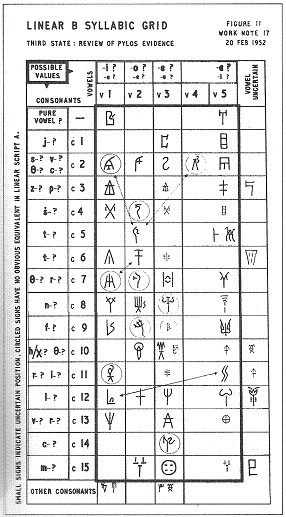
Ventris was an architect, and I think his architectural training, discipline, and practices were an important contributing factor in his success with Linear B.

It’s interesting to note that Ventris’s grid-based system for decipherment is reminiscent of the schedules architects use to lay out information in their drawings.

But more important for Ventris’s success with Linear B was his value of collaboration, also an important architectural practice.

Robinson quotes classicist Thomas Palaima describing Ventris’s practice of “group working, hypothesizing and brainstorming” and adds that

In other words, he did not believe in the idea of the genius who works solo and finally solves a problem by his own sheer unaided brainpower …

Ventris explained in writing and in tremendous detail each stage of his attack on Linear B, and then circulated these neatly type “Work Notes” (Ventris’s name for them) to other scholars for comments and contradictions.

Much of what he hypothesized turned out to be irrelevant or wrong, but this did not stop him from showing it to the professionals. And it appears that he did take this whole approach from his work as an architect.

To me this stresses the immense value of multi-disciplinary teams, cross-fertilization, and collaborative approaches in all kinds of innovation work.

Also important was Ventris’s humility and willingness to recognize his own errors, in contrast to Evans’s stubborn insistence on his Minoan theory.

Ventris and other scholars had for a time favored the idea that Linear B was used to write the Etruscan language. However, after it became evident that the Linear B language was Greek, writes Robinson,

… in a measured and slightly diffident voice [Ventris] announced his discovery on BBC radio, publicly renouncing his long-cherished Etruscan hypothesis … As John Chadwick much later said of Ventris: “The most interesting fact about his work is that it forced him to propose a solution contrary to his own preconceptions.”

This is a worthy example for all experts, who are far too inclined to hop on a particular hobby-horse and just keep on riding it for their entire careers.

These lessons bring to mind some research that we have done at the Institute for Innovation in Large Organizations in the area of cross-functional teaming, a valuable process for innovation work.

(Most of our reports are limited-circulation and confidential. However, we do sometimes quote them as I will do here, and a few of our reports are available on request.)

Here are some points on the value of team diversity in product design from one of our reports:

Bringing people from many disciplines and functions together in design teams offers great potential as a strategy to produce innovative products. However, such diversity also lays the groundwork for conflict. Thus team leaders and company management need to manage team diversity so all members can be effective and make their contribution.

Mitzi Montoya, Zelnak Professor of Marketing at North Carolina State University (NCSU) and executive director of the Services and Product Innovation Management Initiative at the school, says that companies need to recognize the likelihood of conflict and miscommunication and “put processes in place that will manage that inevitable consequence.” The problems that arise from team diversity “have to do with how the organization is structured, who those people report to. It often has nothing to do with the project itself.”

Bob Pagano of Red Sky Insights points out that diversity can bring value to the product design process by putting blue-sky innovators in the same room with more hard-nosed practical players.

You’re going to have some people around the table who are really creative and are going to look at the assignment with a really open mind. You want to have some very creative people early on who might see something outside the normal way of doing things. If they say something really bizarre, we don’t necessarily want to discourage that.

But you also need some enforcers, the ones who are going to put up the barriers, the ones who will push back, but trying to reach a common ground. They might say, ‘Well, that’s interesting. Let’s see if we can do that within the rules on the retail end.’ It’s kind of a give and take to see that nothing gets overlooked.

In our ILO report, we also found that, aside from their contributions from a functional perspective, individual team members contribute different personal qualities to the life and work of a product design team. These different characteristics can offer value in unique ways and can come into play at different stages in the process:

Innovation consultant Stephen M. Shapiro, previously an Accenture consultant, believes that it is important to “understand the various innovation styles of team players” to make use of their distinctive strengths.

Speaking with ILO researchers, Shapiro explained how he classifies these styles:

Analytical people tend to be more focused on intellectual activities and often find flaws in everything.

Structured people want to know the plans and how things will be carried out. They also are a bit more critical but are more action oriented.

Creative individuals are cerebral yet like to think broadly. They are enthusiastic and generators of new ideas. But they are often poor at implementation.

Relationship-oriented people are needed to get anything done as they can engage the organization. But they often are too focused on consensus, which is a barrier to innovation.

Shapiro believes that “once people understand their styles and the associated strengths and weaknesses, they can be more effective in how they work together.” In his view:

The innovation process goes from analytical—define the problem . . .

to creative—define solutions . . .

to structured—define plans . . .

to relationship-oriented—engage the organization.

Thus, the various players’ personal styles can come to the fore at different stages of the group’s work.

But do team diversity and cross-fertilization translate into financial results?

Our work on this report suggested that that less diverse teams tend to produce better financial results overall than highly diverse teams. However, if the company is seeking high-value breakthrough results, it is more likely to achieve those through greater diversity in design team membership:

Lee Fleming, business administration professor at Harvard Business School, writes in Harvard Business Review that highly diverse, cross-disciplinary innovation teams introduce certain risks (“Perfecting Cross-Pollination,” September 2004). After researching 17,000 patents, he believes that

The financial value of the innovations resulting from such cross-pollination is lower, on average, than the value of those that come out of more conventional, siloed approaches. In other words, as the distance between the team members’ fields or disciplines increases, the overall quality of the innovations falls.

However, he adds a big but:

But my research also suggests that the breakthroughs that do arise from such multidisciplinary work, though extremely rare, are frequently of unusually high value—superior to the best innovations achieved by conventional approaches.

Fleming comments that “when members of a team are cut from the same cloth,” as with a group of all marketing professionals, “you don’t see many failures, but you don’t see many extraordinary breakthroughs either.”

However, as team members’ fields begin to vary, “the average value of the team’s innovations falls while the variation in value around that average increases. You see more failures, but you also see occasional breakthroughs of unusually high value.”

AB — 21 Nov. 2009

Social Critics on Social Darwinism: How Rushkoff and Wiker Converge

I recently completed two books by two very different authors, Douglas Rushkoff and Benjamin Wiker. However, the serendipitous fact that I read them one right after the other brought home to me some intriguing commonalities between the two, focusing particularly on the widespread societal effects of social darwinism.

The two books are:

Although I suspect that these two authors would be very far apart on political issues, my reading of these two books in juxtaposition emphasized two interesting commonalities:

  • Both authors comment on the origins and dangers of social darwinism.
  • The two authors both focus their historical analyses on roughly the same time period, from the Middle Ages to the present day.

In writing the above, I also came to an interesting realization on another more-subtle commonality: Wiker starts with the classic cynical treatise The Prince, by Niccolo Machiavelli. Rushkoff starts with the Middle-Age “princes” who created the corporation and imposed central currency in Europe.

Rushkoff’s premise is that the aristocracy in the Middle Ages devised the chartered corporation as a legal mechanism to give them control over commerce and wealth. Because of their privileged status granted by government, corporations have progressively gained more power, even becoming legal “persons” over time.

Rushkoff’s criticism is that Western society has become steeped in corporatism, and that this pits individuals against one another in a win-lose competitive struggle. People operate according to unconscious corporatist values and assumptions about how life should be and are prevented from connecting in a natural way through communities.

Wiker’s premise is that modern civilization has been affected by a materialistic, atheistic philosophical tradition preserved and promoted by a series of highly-influential thinkers and their books, starting with Machiavelli, then Thomas Hobbes, Rene Descartes, John Stuart Mill, Karl Marx, Charles Darwin, Sigmund Freud, Margaret Sanger, Margaret Mead, and Alfred Kinsey, along with others along the way.

As I said, where I see an important commonality between Rushkoff and Wiker is when it comes to their implications and comments about social darwinism: The modern world is strongly influenced by the idea that the natural order demands that the strong survive and the weak die off.

Ruskoff writes,

Richard Dawkins’s theory of the “selfish gene” popularized the extension of evolution to socioeconomics. Just as species competed in a battle for the survival of the fittest, people and their “memes” competed for dominance in the marketplace of ideas.

Human nature was simply part of biological nature, complex in its manifestations but simple in the core commands driving it. Like the genes driving them, people could be expected to act as selfishly as Adam Smith’s hypothetical primitive man, “the bartering savage,” always maximizing the value of every transaction as if by raw instinct.

Ironically, says Rushkoff, religionists were used to promote a compatible economic regime:

Right-wing conservatives turned to fundamentalist Christians to promote the free-market ethos, in return promising lip-service to hot-button Christian issues such as abortion and gay marriage.

It was now the godless Soviets who sought to thwart the Maker’s plan to bestow the universal rights of happiness and property on mankind. America’s founders, on the other hand, had been divinely inspired to create a nation in God’s service, through which people could pursue thier individual salvation and savings.

Rushkoff contends that

What both PR efforts had in common were two falsely reasoned premises: that human beings are private, self-interested actors behaving in ways that consistently promote personal wealth, and that the laissez-faire free market is a natural and self-sustaining system through which scarce resources can be equitably distributed.

Wiker follows the development of atheistic social darwinism from Machiavelli, but he takes considerable time to establish the connection between Darwin and eugenics. On pages 88 to 89 of 10 Books he quotes from Darwin’s Descent of Man (not as well known as On the Origin of Species):

With savages, the weak in body or mind are soon eliminated; and those that survive commonly exhibit a vigorous state of health …. We civilized men, on the other hand, do our utmost to check the process of elimination [by means of various works of charity and relief]. Thus the weak members of civilised societies propagate their kind ….

If … various checks … do not prevent the reckless, the vicious and otherwise inferior members of society from increasing at a quicker rate than the better class of men, the nation will retrograde, as has occurred too often in the history of the world.

Wiker argues that the writings of Darwin and other atheistic thinkers have led to a modern world in which the weak are seen as expendable for the good of human progress.

At the end of his book, Wiker comments:

We are so fond of thinking of our progress from the simple savage that we forget to take account of whether we are really progressing in some sort of virtue or rather becoming more complexly and deviously savage.

We have a higher regard for health than our ancestors did, and a far greater knowledge of biology. But when biology, rather than theology, becomes the queen of the sciences, then Christian prohibitions against eugenics, the elimination of the unfit or the unwanted through abortion or infanticide, or the elimination of diseased races or classes all become merely “medieval” and irrelevant.

Rushkoff and Wiker approach their analyses with very different objectives and foci, and it would be far from accurate to say that they reach the same conclusions.

But both Life Inc. and 10 Books That Screwed Up the World shine light on some of the historical and philosophical sources of the great streak of heartlessness evident in the modern world.

In about 1970, I was picked up hitchhiking on I-85 in North Carolina by an older fellow driving a sedan. We got into a conversation about the problems of the world. From his point of view, one of the biggest problems was welfare and charity — all the giveaway programs that are supposed to help the poor.

I raised the question, Well, what are they supposed to do? Suppose they need help to survive and get back on their feet?

His response was, “Who cares? Let ’em die. That’s the way nature works.”

I wonder who he had been reading.

AB — 4 September 2009

New wristwatch uses a linear rather than circular clock face

Just yesterday I read on The Watchismo Times (a blog dedicated to unusual timepieces) about a new mechanical wristwatch designed with a linear time display rather than the traditional circular clock face. (See “Urwerk King Cobra CC1 Reintrepretation of 1958 Patek Philippe Cobra Prototype – Cylindrical Retrograde Linear Jumping Hour Display.”)

This design is thought-provoking: We normally conceive of time as a line, and yet for centuries the standard timepiece interface has been a circle. The author of the Watchismo site explains why this is:

Why do we think of time as travelling in a straight line yet display it rotating around a circle? The answer is straightforward: mechanisms that continually rotate are much simpler to produce than those that trace a straight line then return to zero. In fact, the latter is so difficult that, until now, nobody has ever managed to develop a production wristwatch with true retrograde linear displays.

It makes me think about how I conceive time personally. In the big picture, I think I do see time as a straight line going infinitely to the left and right.

In spite of the more linear design of the calendars I use, I believe I conceive of the calendar as a circle, as if the year were superimposed on a standard clock face. However, in my mind, the calendar runs counterclockwise with January at approximately the 11:00 position. I think my circular conception of the calendar comes from the periodic nature of the solar year. Why the year goes counterclockwise in my mind I don’t know.

When it comes to my conception of days, though, I see some ambiguities. I do conceive of them on some level as a circle of 24 hours, but on reflection I think that conception is at least partly based on the circular clock faces we use to keep time, as well as on the collective 24-hour standard we use to keep our society synchronized.

Certainly the new Urwerk King Cobra CC1 provides food for thought about how we think about time and about the user interfaces of the devices we use to keep track of it. Below is a link to Watchismo’s picture of the watch. Watchismo also provides many fascinating details about how the watch is designed and constructed.

Urwerk linear wristwatch

AB — 10 July 2009