Bad Economy – While They’re Moping Around, You Can Be Mopping Up

What I keep hearing is that businesses don’t want to expand, take risks, or hire new people because they don’t know what direction the economy’s going to go. Supposedly this fear turns into a self-fulfilling prophecy, because most businesses are thinking the same way and nobody’s willing to get moving to generate more business in the economy.

I have to think that this represents an opportunity for businesses large and small that are willing to get off their butts and start doing something. While the competition is busy wringing their hands, you can be out gaining market share.

While the competition is skimping on their marketing budget, you can expand yours and gain more visibility in the marketplace.

While the competition is afraid to take risks and try new things, you can invest in some product development and market testing to get a new product out on the market at a discount rate.

Since the competition is afraid to hire new employees, you are in a position to hire someone good at a reasonable rate. What about taking on a part-timer? A paid intern? A promising young person with little hard experience? A bright, creative, diligent worker who only has a high-school degree? An older person who might appear “over-qualified” on paper but would love to have a great job working for you?

AB — 2 September 2011

Programs for Recycling Food Scraps Gaining Traction

Recently at ThomasNet Green & Clean, I wrote about programs that are starting up around North America to recycle food scraps from homes, institutions, and businesses — see “Not Your Grandma’s Compost Pile – Increasing Efforts to Recycle Food Scraps.

This movement could have a significant impact on the waste stream, as I discovered from EPA data:

Government has begun to recognize that much of its waste stream is material that could be disposed of beneficially rather than simply being sequestered in a landfill emitting methane. The United States Environmental Protection Agency (EPA) … estimates that food scraps make up 14.1 percent of solid waste generated in the U.S., 34 million tons of food waste total. However, only 2.5 percent of that volume gets recovered.

AB — 28 August 2011

How the Internet Reinforces Confirmation Bias

Recently I wrote about confirmation bias in connection with the climate change controversy — see my article at ThomasNet, “All This Wrangling Over Climate Change – What’s Up With That?” The Skeptic’s Dictionary refers to confirmation bias as “a type of selective thinking whereby one tends to notice and to look for what confirms one’s beliefs, and to ignore, not look for, or undervalue the relevance of what contradicts one’s beliefs.”

Today I ran across an interesting TED Talk (TED hosts and posts video talks on innovative topics) by political activist Eli Pariser who has some interesting things to say about how the algorithms used on web sites such as Facebook and Google tend to reinforce our current thinking and filter out new ideas — see his talk, “Beware Online ‘Filter Bubbles‘” — well worth watching, only nine minutes.

Pariser explains what he means by a filter bubble:

Your filter bubble is kind of your own personal, unique universe of information that you live in online … the thing is, you don’t decide what gets in, and more importantly, you don’t actually see what gets edited out.

If you and I both search for the same thing at the same time on Google, for example, we get different results. The danger of the filter bubble, says Pariser, is that

this moves us very quickly toward a world in which the Internet is showing us what it thinks we want to see, but not necessarily what we need to see.

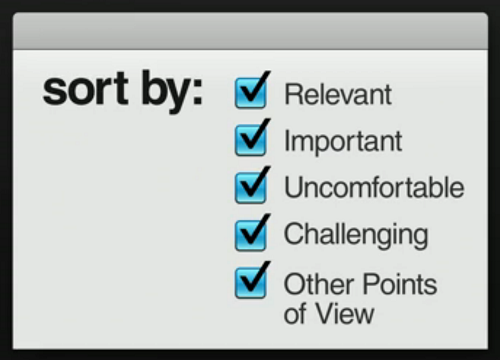
He suggests that a personalization algorithm deciding what to show us needs to look not just at what it thinks is “relevant,” but at other factors too, such as those in this slide from his presentation:

This seems like a great insight. Anyway, I highly recommend this short video to get you thinking outside the box:

AB — 24 August 2011

National Wildlife Federation’s 140,000 Backyard Habitats

On ThomasNet Green & Clean last week, I wrote about the National Wildlife Federation’s Certified Wildlife Habitat Program (see “Bunnies, Bluebirds, and Butterflies – A Wildlife Habitat in Your Backyard?“), which has registered 140,000 wildlife habitats in backyards, schools, parks, businesses, and government properties since 1973.

I learned about the program by serendipity — driving through a neighborhood here in Raleigh, I noticed the NWF sign in someone’s yard, and decided to investigate the program with the idea of writing an article about it.

Landscaper John Magee told me he thinks the program is helping to restore some of the original forest that has been lost through development:

Even as habitat becomes more and more disrupted by development, we’re creating more and more little islands of habitat. Wildlife can move and migrate from one to another of them. Areas that used to be forest are now subdivisions, but as we create more islands it makes things easier for wildlife. We can reconnect things more back the way they probably should be.

AB — 14 August 2011

Why Climate Change Is Controversial — or Is It?

My article at ThomasNet last week generated some controversy — see “All This Wrangling Over Climate Change – What’s Up With That?” Commenters on multiple ideological sides of the debate chimed in with comments — passionate but civil, for the most part.

Some readers were frustrated with me because I took a more or less neutral stance. Not that I have no opinions about climate change. It’s just that my purpose in this case is to try to shed some light on the controversy as a controversy. Here is a key excerpt:

Grappling on the global-warming battlefield are two parties in a high-stakes political conflict: On the extreme ends of the global warming controversy, believers accuse skeptics of pushing “free-market fundamentalism”; skeptics accuse believers of pushing “eco-socialism.”

According to one narrative, market fundamentalists and corporate interests are funding an intentionally-deceptive propaganda campaign against the concept of human-caused global warming to keep business free from regulatory interference…

According to the opposing narrative, communism has reformulated itself as a leftist environmental movement bent on establishing a world government and destroying free-market capitalism.

This is my second article in a series on climate change. The previous one examined research into public perceptions of the issue — see “Does the Public Really Believe Humans Are Causing Climate Change?

AB — 9 August 2011

Market Turmoil, Just the Pregame for the Main Event?

Umair Haque today does a pretty good job of terrifying anybody who pays attention to the economy — see “Market Correction? Try Perma-Crisis.” According to Haque, if those in charge don’t do something to restructure their dysfunctional institutions, we could be “on the Express Train to the Federation of Banana Republics.” In such case, he thinks “today’s market turmoil is probably just the pregame for the main event.”

Haque says that about the current economic crisis:

[I]t’s fundamentally grounded in the institutions we use to (mis)manage the economy. They’re deeply broken, and throwing money at broken institutions doesn’t fix them — it does the very opposite: it entrenches them, shores them up, fortifies them against the future.

He outlines six lessons on crisis that help explain why the situation is self-perpetuating, including:

When people who are prisoners of the paradigm that caused the crisis are in charge of fixing it, bet on … more crisis.

AB — 5 August 2011